



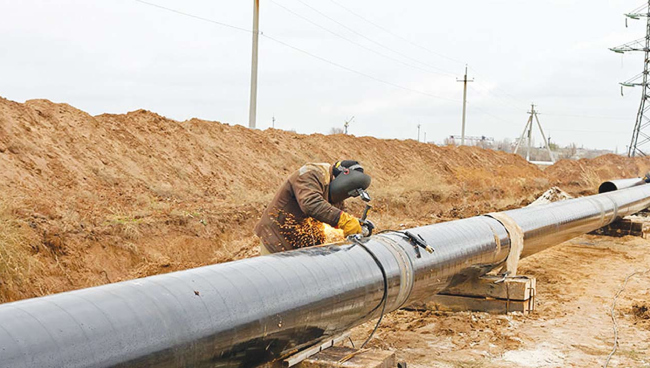
Nigeria hopes to begin delivering natural gas to Abuja by July through its long-delayed Ajaokuta-Kaduna-Kano (AKK) gas pipeline.
According to the Nigerian Upstream Petroleum Regulatory Commission (NUPRC), this marks a key milestone for the country’s gas development plans.
“We’re hoping that by July, gas will be delivered to Abuja through the AKK gas pipeline,” a spokesperson for the commission told the regulator’s in-house magazine.
The 614-kilometre (382-mile) pipeline is designed to deliver more than 2.2 billion cubic feet of gas per day and is a core part of Nigeria’s strategy to shift its energy mix towards gas, supply power plants and industries in the north, and reduce reliance on diesel and fuel oil.
Nigeria holds Africa’s largest gas reserves, estimated at over 210 trillion cubic feet, but much of the country’s gas infrastructure remains underdeveloped, making the AKK pipeline a critical test of its gas-led growth ambitions.
The $2.8 billion project, first conceived in 2008, has missed several delivery targets, including earlier deadlines of 2023 and the final quarter of 2025.
Construction began in 2020 but was slowed by funding pressures and engineering challenges, most notably the crossing of the River Niger.
That section, widely regarded as the project’s most technically demanding, required drilling beneath the riverbed using horizontal directional drilling, often compared to a scaled-down version of the Eurotunnel.
Reuters reported that work on the project is moving at an advanced pace, with the critical pipeline more than 90% complete.
Gas transported through the AKK pipeline will be sourced from Nigeria’s southern producing areas largely through its interconnection with the East-West Obiafu-Obrikom-Oben (OB3) gas pipeline, according to industry officials.
