



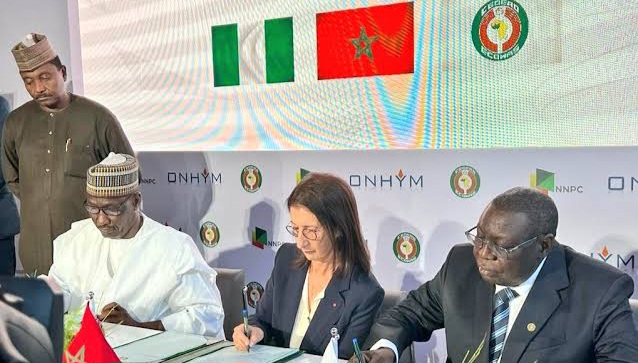
The Summit of Heads of State and Government of the member countries of the Economic Community of West African States (ECOWAS) hosted, Sunday in Freetown, Sierra Leone, the signing of the Intergovernmental Agreement (IGA) governing the development of the Nigeria-Morocco African Atlantic Gas Pipeline.
The 6,800-kilometer energy infrastructure will transport natural gas from Nigeria to Morocco, before connecting to the European gas network.
The agreement marks ECOWAS Member States endorsement of the Nigeria-Morocco African Atlantic Gas Pipeline.
King Mohammed VI and former Nigerian President, the late Muhammadu Buhari launched the project in 2016. The project received continued support from current President Bola Ahmed Tinubu. T
The project is being jointly developed by Morocco’s National Office of Hydrocarbons and Mines (ONHYM) and the Nigerian National Petroleum Company Limited (NNPC Ltd.).
The agreement will act as a framework paving the the way for the next implementation phase.
The next phase will include the establishment of the Project Company, to be headquartered in Casablanca
It will also cover the Pipeline Higher Authority, whose headquarters are planned for Abuja, ahead of the mobilization of investors and the preparation of the Final Investment Decision (FID).
The final stage will include a ceremony that Morocco will organize. The ceremony will mark the signing of an agreement between Morocco and Mauritania, in the presence of the President of the Federal Republic of Nigeria.
The gas pipeline is set to cross 13 countries along Africa’s Atlantic coast and connect to the Maghreb-Europe gas pipeline in northern Morocco.
It will have a transport capacity of 30 billion cubic meters of natural gas per year, of which up to 15 billion cubic meters could be exported to Morocco and Europe, with the remainder destined to supply regional markets.
The project is estimated at approximately $25 billion, with the infrastructure aiming to establish an integrated regional natural gas market across West Africa, support electricity generation, industrialization, and the development of the continent’s natural resources.
The commissioning of the first pipeline segments is expected at the beginning of the next decade
