



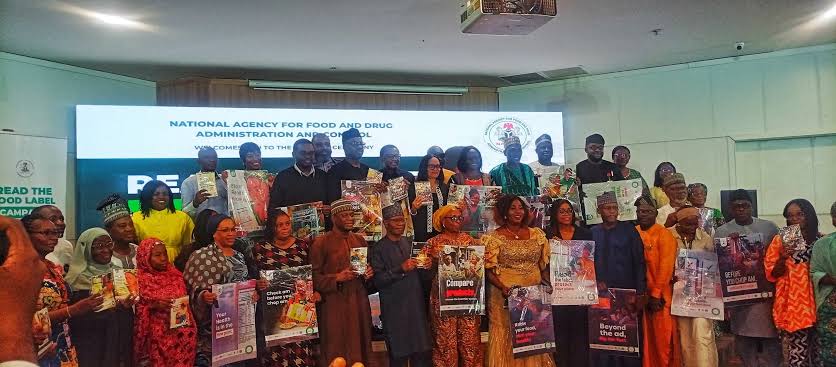
The National Agency for Food and Drug Administration and Control (NAFDAC) has launched ‘read your label’ campaign to ensure consumers’ safety.
The campaign also aims to curb the rising non-communicable diseases (NCD) burden linked to the excessive consumption of ultra-processed food (UFP).
Speaking at the launch of the campaign in Abuja, Mojisola Adeyeye, director-general of NAFDAC, said that the ability to read food labels effectively could have a direct impact on disease prevention and management.
Adeyeye noted that non-communicable diseases account for about 29 percent of deaths in Nigeria, of which cardiovascular diseases, cancer, chronic respiratory diseases, and diabetes are responsible for 11 percent, 4 percent, 2 percent, and 1 percent, respectively.
“Many of these deaths can be traced to consumption of salt, sugar, saturated fats, trans fats, and highly processed foods. All this contributes significantly to this problem – the ability of consumers to understand, interpret, and apply information on food labels has become more important,” Adeyeye said.
“In an increasingly plastic food environment, characterized by urbanization, food marketing, and the growing availability of ultra-processed food packaging, consumers are confronted with an unprecedented number of food choices every day.
“For individuals living with specific health conditions such as hypertension, diabetes, obesity, food allergies, and so on, the ability to read and use food labels effectively can have a direct impact on disease prevention and management.”
The director-general added that the campaign would create accountability between the consumers and manufacturers.
On sensitisation and dissemination, Chinyere Ikejiofor, head of nutrition, food safety, and applied nutrition, said the campaign is designed to equip consumers with the knowledge to interpret nutrition information while strengthening public understanding of the Pre-Packaged Food Labelling Regulations 2022.
Ikejiofor noted that the first phase involved establishing internal implementation structures, the second phase will focus on capacity building, the third phase will emphasise on behavioural change through market road shows, and the final phase will focus on sustainability through impact evaluation.
Meanwhile, Akinbode Oluwafemi, executive director of Corporate Accountability and Public Participation Africa (CAPPA), said “aggressively” and “deceptively” marketed ultra-processed food and beverage products are worsening Nigeria’s non-communicable diseases burden.
Akinbode, who was represented by Abayomi Sarumi, CAPPA’s healthy food policy manager, added that reading food labels helps consumers identify products that contain high levels of sugar, salt, trans fats, and other nutrients of concern with diet-related illnesses such as hypertension, diabetes, obesity, stroke, and heart disease
