



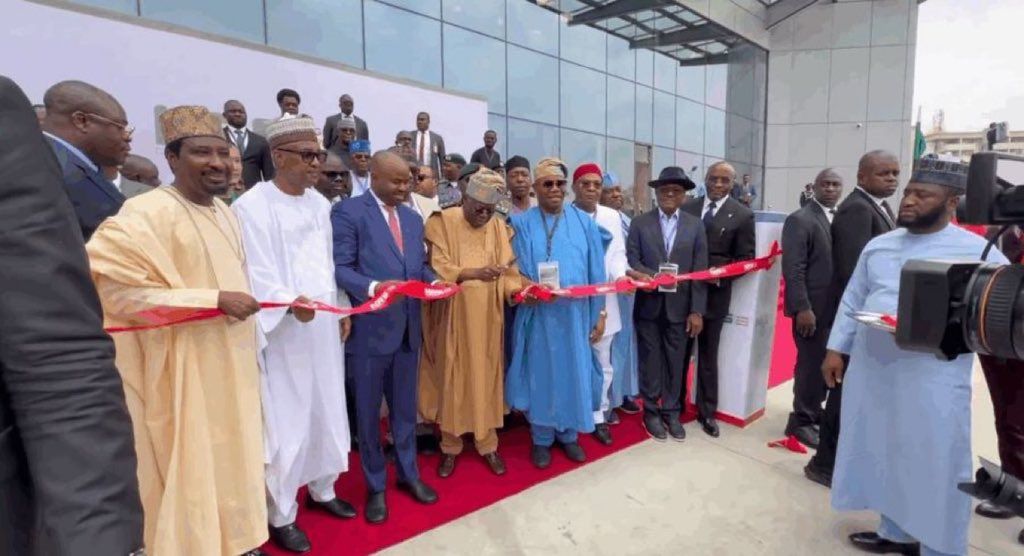
President Bola Tinubu says his administration’s economic reforms are aimed at confronting structural weaknesses, restoring fairness, and rebuilding confidence in public institutions.
Tinubu spoke on Tuesday at the commissioning of the Nigeria Revenue Service (NRS) headquarters in Abuja.
The president said the government is focused on building an economy anchored on discipline, equity, and opportunity, adding that the reforms being implemented are not merely rhetorical but a “covenant” with Nigerians.
“We are here to mark a milestone in the Nigerian national journey — a reaffirmation of our fiscal foundation and a rebuilding of confidence in public institutions,” he said.
“No serious nation can achieve lasting prosperity on a weak and fragmented economic system. No government can demand trust from its citizens when taxation is opaque, inefficient, or unjust.”
The president said the administration took “bold decisions” to implement far-reaching fiscal reforms designed to simplify the system, eliminate distortions, and create a transparent, investment-friendly environment.
According to Tinubu, the direction of the reforms is to establish a revenue system that rewards enterprise, supports growth, and ensures fairness for all contributors to the national economy.
He said early results of the reforms are already evident in improved fiscal stability, stronger foreign reserves, a more efficient trade ecosystem, and rising investor confidence.
“These gains are not incidental. They are the result of deliberate policy, sustained effort, and the collective resolve to do what is right for the long-term prosperity of our nation,” he said.
The president described the newly commissioned NRS headquarters as more than a physical structure, noting that it symbolises a new standard of professionalism, transparency, efficiency, and service.
Providing details of the facility, Tinubu said the headquarters comprises 16 floors across three towers, with capacity to accommodate over 3,000 personnel.
‘BUILDING TO SERVE AS OPERATIONAL BACKBONE OF REFORMED REVENUE SYSTEM’
The president said the building is designed to serve as the operational backbone of a reformed revenue system, reflecting the scale and ambition of Nigeria’s fiscal transformation.
He noted that the restructured Nigeria Revenue Service now operates under an expanded legal mandate that goes beyond tax administration to include the coordination of non-tax revenues across federal agencies.
Tinubu said NRS’ new framework prioritises digital-first enforcement, data-driven compliance, an expanded taxpayer base, and a governance structure built for accountability — marking a clear break from past inefficiencies.
“These are not incremental adjustments to what existed before, but a deliberate rupture with a past defined by leakage, fragmentation, and underperformance,” he said.
Tinubu charged the agency to go beyond revenue collection and prioritise trust-building, fairness, and accountability in its operations.
“We must not only collect revenue; we must build trust. We must ensure fairness and demonstrate that government can be accountable, efficient, and responsive,” the president said.
He also commended Nigerians for their resilience amid ongoing reforms, urging public institutions to rise to meet performance expectations.
“The work of nation-building demands consistency, courage, and collective resolve. Nigeria’s future will not be determined by chance but by the decisions we make together,” Tinubu said.
“We have chosen reform. We have chosen discipline. We have chosen progress.”
The president added that the completion of the project signals a shift from promises to tangible delivery, expressing confidence that Nigeria’s future will be defined by stronger institutions and improved prosperity.
Tinubu thereafter declared the facility open
