



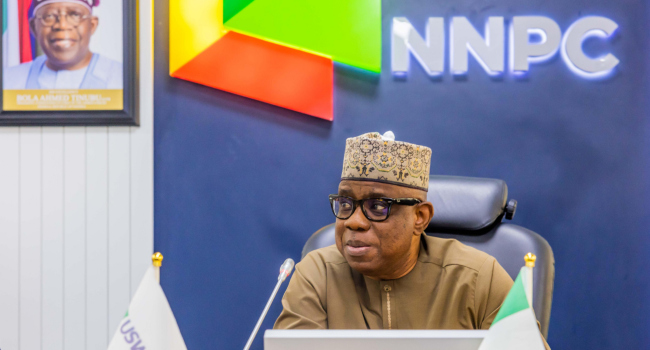
The Nigerian National Petroleum Company Limited (NNPC) on Wednesday announced that it has begun a detailed review of Nigeria’s three petroleum refineries, with a view to bringing them back online.
In a post on his verified personal X handle Wednesday night, the Group Chief Executive Officer of the national oil company, Bayo Ojulari, stated that one of the options being explored by the NNPC is to search for technical equity partners to ‘high-grade or repurpose’ the facilities.
Tagged: “Update on Our Refineries”, Ojulari stated that the NNPC continues to remain optimistic that the refineries will operate efficiently, despite current setbacks.
In spite of spending about $3 billion on revamping the refineries, only the 60,000 barrels per day portion of the facility worked skeletally for just a few months before packing up. The Warri refinery remains comatose weeks after it was gleefully announced to have returned to production, while the Kaduna facility never took off at all.
Africa’s richest man, Aliko Dangote, in July, estimated that the federal government may have spent over $18 billion over the years to revamp the three refineries without results.
Despite the deployment of these huge resources without commensurate output, nobody has been punished for any infraction by the Nigerian government.
“As of today (July), they have spent about $18 billion on those refineries, and they are still not working. And I don’t think, and I doubt very much if they will work,” he said.
Dangote emphasised that the turnaround maintenance of the refineries was like trying to modernise a car built 40 years ago, when technology has advanced.
But sounding a note of optimism, Ojulari, who posted the message with a hashtag #Nigerian refineries will work, explained that the NNPC has developed a strategy to ensure that this aspiration comes to fruition.
“We are filled with determination! We are looking ahead with optimism to ensure our refineries operate effectively. We are dedicating significant time to a detailed review and are eager to implement our insights.
“What fuels our drive is the understanding that the prosperity of the Nigerian states and the future success of Nigeria will always take precedence over any individual interests.
“This very commitment inspires us as we anticipate creating sustainable solutions for our refineries in the near future. #Nigerianrefineries #willwork”, he wrote.
Outlining the fresh plan under several subheadings including Technical & Commercial Review; Advanced Technical Partnerships as well as Energy Security & Asset Optimisation, the NNPC GCEO stressed that the technical equity partners to be selected, must have a track record of operating refineries to international standards.
“He wrote: “Ongoing technical and commercial review for comprehensive assessment of all three refineries. To high-grade or repurpose as may be required to ensure optimal performance and sustainability.
“Advanced Technical Partnerships. Select Technical Equity Partners who have a track record of operating refineries to international standards. Complete requisite agreements to mobilise towards implementing high-grade or repairs as required.”
As for Energy Security & Asset Optimisation, Ojulari pointed out that this is to assure NNPC’s capacity to meet Petroleum Industry Act (PIA) requirements as the supplier of last resort for petroleum products as well as to ensure efficient and profitable operation of the refineries.
“We’re repositioning as a commercially driven, transparent energy company serving Nigerians,” Ojulari added.
During his tenure, erstwhile GCEO, Mele Kyari, oversaw the award of rehabilitation contracts for Nigeria’s three main state-owned refineries at amounts running into the billions of US dollars.
For the Port Harcourt Refining Company (PHRC) in Port Harcourt, the Federal Executive Council (FEC) approved a contract of roughly $1.50 billion. For the Kaduna Refining & Petrochemical Company (KRPC) in Kaduna and the Warri Refining & Petrochemical Company in Warri, a combined contract sum of about $1.48 billion was approved.
In total, therefore, the rehabilitation of the three refineries was budgeted at approximately $3 billion, prompting the Economic and Financial Crimes Commission (EFCC) to have recently begun an investigation.
Meanwhile, Nigerians are about to pay as much as N150 higher per litre of petrol and higher than that on diesel, after the Bola Tinubu-led administration approved a 15 per cent tariff on imported fuels, implementation of which will commence immediately. However the document stated that the impact will not exceed N100 addition per litre.
The document seen by THISDAY on Wednesday copied to the Attorney General of the Federation, Lateef Fagbemi; Executive Chairman Federal Inland Revenue Service (FIRS), Zacch Adedeji and the Authority Chief Executive of the Nigerian Midstream and Downstream Petroleum Regulatory Authority (NMDPRA), Farouk Ahmed, confirmed the development.
The request approved by the President stated that the proposal to introduce a ‘measured import tariff’ on Premium Motor Spirit (PMS) and Diesel, was aimed at reinforcing national energy security, safeguarding local refining capacity, stabilising the downstream market, and ensuring a fair and competitive pricing environment aligned with the the President’s agenda.
“Your Excellency may wish to recall that on 29th July 2024, via Federal Executive Council Memo EC 9 (2024) 4, you graciously approved the settlement of crude oil dedicated to domestic consumption in Naira, alongside the sale of the refined products therefrom in Naira.
“The core objective of this initíative is to operationalise crude transactions in local currency, strengthen local refining capacity, and ensure a stable, affordable supply of petroleum products across Nigeria – aligning with Your Excellency’s Renewed Hope Agenda for energy security and fiscal sustainability.
“However, Your Excellency may wish to additionally note that while domestic refining of PMS has begun to increase, and local sufficiency in Diesel production has been achieved, price instability persists, partly due to misalignment between local refiners and marketers.
“Import parity remains the benchmark for pricing but often sits below the cost recovery point of local producers, particularly during currency and freight fluctuations. Left unchecked, these risks undermine our nascent refining sector at the very point of recovery. The Government’s responsibility is therefore twofold: to protect consumers and domestic producers from unfair pricing practices and collusion, while simultaneously ensuring a level playing field that allows domestic refiners to cover costs and attract continued investment,” the official communication stated.
Pursuant to the above, and with the goal of driving a sustainable, fair, and equitable ecosystem, the letter detailed by a personal aide of the President proposed that the tariff framework be introduced.
This framework, the official communication said, is designed to prevent duty-free imports from undercutting local refineries, while maintaining healthy competition and protecting consumers.
“In line with the objectives of Your Excellency’s earlier approval, it strengthens the local value chain, stabilises prices, and incentivises investment into refining and logistics infrastructure. In alignment with the updated technical proposal, it is recommended that an ad-valorem import duty of 15 per cent be introduced on PMS and Diesel, applied to the Cost, Insurance, and Freight (CIF) value at discharge.
“At current CIF levels, this represents an increment at approximately N99.72 per litre, which nudges imported landed costs toward local cost-recovery without choking supply or inflating consumer prices beyond sustainable thresholds.
“Even with this adjustment, estimated Lagos pump prices would remain in the range of N964.72 per litre ($0.62), still significantly below regional averages such as Senegal ($1.76 per litre), Cote d’Ivoire ($1.52 per litre), and Ghana ($1.37 per litre),” the request acceded to by the President stated.
The proponents argued that the tariff is not revenue-driven but corrective, aimed at aligning import costs with domestic realities while preserving affordability.
According to the document, payments would be made into a designated Federal Government of Nigeria (FGN) revenue account under the Nigeria Revenue Service (NRS), with verification by the NMDPRA before discharge clearance.
While the document suggested that implementation would commence after a 30-day transition window, allowing importers to adjust cargoes already in transit and ensuring a smooth rollout without market disruption, however it indicated that the President minuted that it should begin immediately. “Approved as Prayed for Implementation Immediately,” the Nigerian leader wrote.
The letter continued: “Sections 71 and 72 of the Petroleum Industry Act (PIA) provide the legal basis for the proposed import tariff. Section 71 (a) and (b) empowers the Nigerian Midstream and Downstream Petroleum Regulatory Authority (NMDPRA) to issue Regulations imposing public service obligations on licensees in relation to matters which include security of supply, economic development, and the achievement of wider economic policy objectives.
“Section 72 went further to authorise NMDPRA to provide for the recovery of any additional costs incurred in complying with the public service obligations through a public service levy, which may be imposed on customers, provided that it would be in the wider public interest.
“Public service obligations’” are defined under section 318 of the PIA to mean: specific obligations imposed by the Authority on licensees in relation to security of supply, social service, economic development, environmental protection or the use of indigenous materiais.
“Accordingly, Your Excellency can achieve this by giving policy directives to NMDPRA under section 3(4) of the PIA the 15 per cent import tariff on PMS and Diesel, which shall be published in the Federal Government gazette,” it added.
In line with the above, the letter stated that operationalisation will be straightforward and transparent as tariffs will be collected into a designated federal government revenue account issued by the FIRS, now NRS.
In addition, it stated that end-to-end digital verification will be linked to NMDPRA discharge clearance, ensuring no cargo is released without proof of payment, while Customs and NMDPRA will update import templates, supported by a public compliance notice to minimise speculation and rumour-driven volatility.
“A 30-day transition period will be observed to allow market participants to adjust cargoes already in transit. In conclusion, this reform will accelerate Nigeria’s path toward fuel self-sufficiency, protect consumers and investors alike, and stabilise the downstream petroleum market. It represents another bold step in Your Excellency’s legacy of reforms that continually strengthen the sustainability and competitiveness of our energy ecosystem.
“In view of the foregoing, Your Excellency is respectfully invited to consider and, if deemed appropriate: Approve the introduction of a 15 per cent ad-valorem import duty on Premium Motor Spirit (PMS) and Diesel, to be assessed on the Cost, Insurance, and Freight (CIF) value at discharge, with all payments made into a designated Federal Government of Nigeria (FGN) revenue account and verified by the Nigerian Midstream and Downstream Petroleum Regulatory Authority (NMDPRA) prior to discharge clearance.
“Direct the Nigerian Midstream and Downstream Petroleum Regulatory Authority (NMDPRA) and the Nigeria Customs Service (NCS) to implement a 15 per cent import duty on Premium Motor Spirit & Diesel, with effect after a 30-day transition period from the date of official notification.
“Direct the Nigerian Midstream and Downstream Petroleum Regulatory Authority (NMDPRA), the regulator, to issue appropriate Regulations in this regard and take local production into account first before the issuance of import licenses.
“Direct a periodic review of the tariff rate and its continued necessity, including provisions for scaling or sunset measures, as domestic Premium Motor Spirit (PMS) refining capacity expands, under the oversight of the Implementation Committee on Crude and Refined Products Sales in Naira,” the letter stated.
However, THISDAY learnt that the development has led to apprehension in the downstream sector of the petroleum industry, as many argue that the country does not have enough refining capacity to add a 15 per cent tariff on imported fuel.
Nigeria currently imports over 60 per cent of its refined petroleum products, while less than 40 per cent is sourced locally, almost solely from the Dangote refinery
