


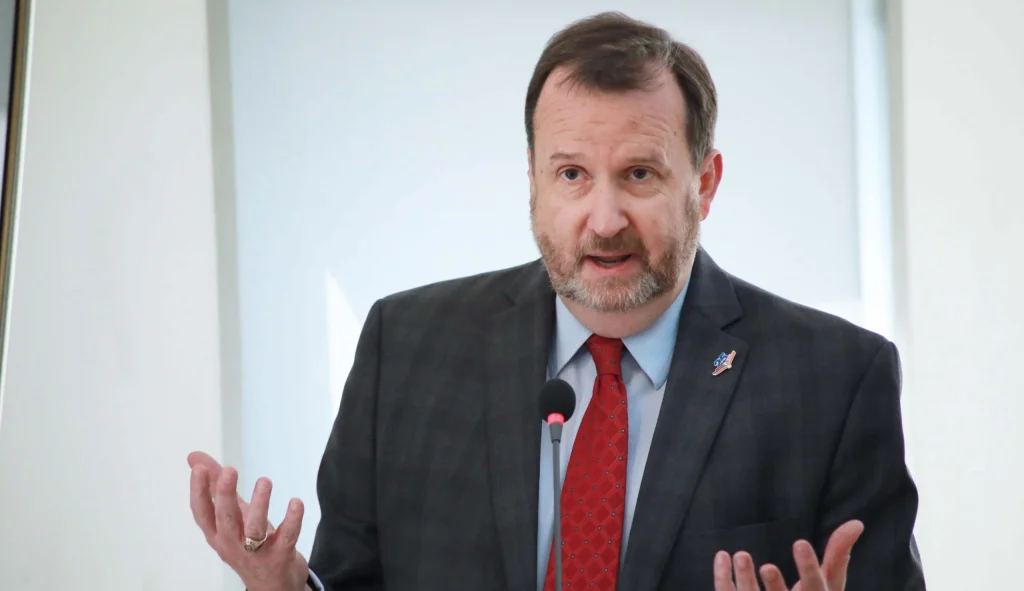
The United States Ambassador to Nigeria, Richard Mills, has dismissed allegations that the United States Agency for International Development (USAID) is funding Boko Haram or any other terrorist organisation, stating that there is no evidence to support such claims.
Speaking after a meeting with the Nigeria Governors Forum in Abuja on Wednesday night, Mills stated that no country condemns Boko Haram’s violence more strongly than the United States.
“If we ever had evidence that any programme funding was being misused by Boko Haram, we would immediately investigate it with our Nigerian partners,” Mills assured.
His comments come in response to allegations made by U.S. Congressman Scott Perry on February 13 during a congressional hearing on government efficiency.
Perry, a Republican from Pennsylvania, had claimed that USAID funds were being diverted to terrorist groups, including Boko Haram.
Following the allegations, the Nigerian Senate called on National Security Adviser Nuhu Ribadu and heads of the National Intelligence Agency and Defence Intelligence Agency to investigate potential terrorist funding involving USAID.
Mills, however, reaffirmed that the U.S. has stringent policies to prevent its aid from being diverted to terrorist groups.
“The United States stands with Nigeria in wanting to rid this country of the scourge that this organization represents,” he said.
Mills clarified, “No assistance has been cut yet, and no final decisions have been made regarding its future. In fact, US Secretary of State Marco Rubio has emphasised that this is not about ending foreign aid to partners like Nigeria but rather about making it more effective and aligned with US government policies and interests.
“That’s the purpose of this 90-day pause. However, life-saving assistance—such as support for HIV patients, maternal and child nutrition, and internally displaced persons—will continue under existing waivers. By the end of the 90-day period, we will have a clearer understanding of the path forward.”
Speaking on discussions with the 36 state governors, the US Ambassador outlined the embassy’s vision for the future of US-Nigeria relations.
“I explained that we are prioritizing four key areas in the coming years. First, improving the business climate to enhance trade and investment between the United States and Nigeria.
“Second, reinforcing transparency and accountability by tackling corruption and amplifying the voices of Nigerians advocating for good governance.
“Third, increasing engagement at the state and local levels. I believe the embassy needs to work more closely with subnational authorities as we shape our programs and assistance.
“Finally, we discussed healthcare initiatives, which form a significant part of US aid to Nigeria. As we achieve progress—such as reducing HIV cases and eradicating polio—we aim to ensure these programs are sustainable and transition them to the Nigerian government at both federal and state levels.”
Mills noted that the goal is to strengthen Nigeria’s healthcare system by ensuring the long-term viability of these programs under local management.
Boko Haram, a terrorist group founded in 2002, has been responsible for thousands of deaths and widespread destruction across Nigeria.
The U.S. designated Boko Haram as a foreign terrorist organisation in 2013, blocking its access to financial assets and imposing sanctions
