


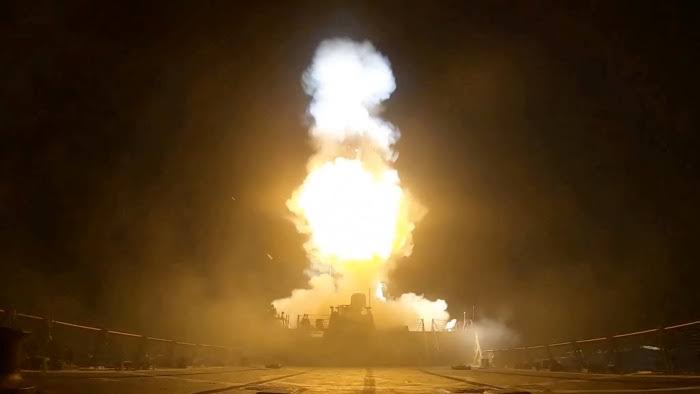
The US has launched its third consecutive night of strikes on Iran hours after Donald Trump said Washington would reinstate a maritime blockade on the country and, in an apparent policy reversal, charge ships for safe passage.
“These strikes will continue imposing a heavy cost on Iranian forces and degrade their ability to attack innocent civilians and commercial shipping in the strait of Hormuz,” the US military’s Central Command said.
Trump had earlier told the conservative radio host Hugh Hewitt: “We’re going to hit them very hard tonight and we’re going to hit them hard tomorrow – and there’s not a damn thing they can do about it.”
He added: “They have nothing. They have nothing going, other than they have big mouths.”
Late on Monday the UAE said two national tankers were targeted by two Iranian cruise missiles in the southern lane of the strait of Hormuz in Omani territorial waters, killing one Indian crew member and wounding eight others, including four seriously.https://interactive.guim.co.uk/datawrapper/embed/oTtdC/1/?dark=false
The price of Brent crude oil, the international standard, rose 7.8% to $81.92 a barrel on Monday, still well below the $120 (£90) reached at the height of the war.
Earlier on Monday, Trump had said the US would demand a 20% tariff on all cargoes shipped through the strait of Hormuz. He suggested in a post on his Truth Social platform that the US should be known henceforth as the “guardian of the strait of Hormuz”, as Iran and the US engaged in some of the heaviest drone and missile exchanges since an interim deal was negotiated to bring an end to the conflict.
Until now, the US had said the strait should remain open to all without tolls – as it was before Washington and Israel attacked Iran on 28 February. Any attempt by the US or Iran to charge fees would violate global norms on freedom of navigation and would be likely to cause further economic disruption far beyond the region.
Trump has made numerous claims and threats during the war on Iran, including frequent claims of victory, many of which have had little grounding in reality.
Iran and the US are in theory nearly halfway through the 60-day period of an interim deal that was supposed to set up talks for a permanent end to the war, which began in February with the assassination of Iran’s supreme leader, Ali Khamenei, in US-Israeli airstrikes.
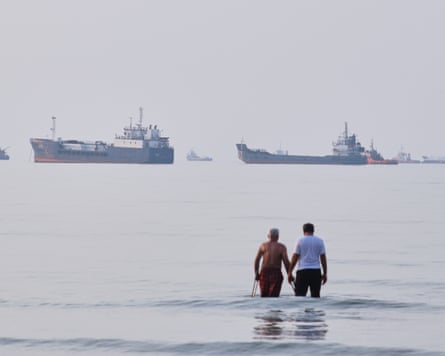
In reality, that deal has devolved into a series of attacks over the strait of Hormuz, resulting in the near-total collapse of an interim ceasefire and worrying world leaders that the conflict could fully resume.
On Monday it was revealed that Trump sent Congress formal notification that hostilities against Iran had resumed on 7 July, a letter his administration sees as opening a new 60-day window to use the military in the region without congressional approval.
The US Constitution says that only Congress, not the president, has the power to declare war. However, US presidents have long claimed the right to order shorter military engagements without lawmakers’ approval to preserve US security. The war powers act requires the president to inform Congress within 48 hours of initiating hostilities, and says military action begun without Congress’ approval must be terminated within 60 days.
Democrats and Republican opponents of the war have accused the administration of misinterpreting the law.
On Monday evening the US Navy-led Joint Maritime Information Center said the US would begin enforcing the blockade on Iran, covering all ports, oil terminals and coastal areas, on Tuesday night.
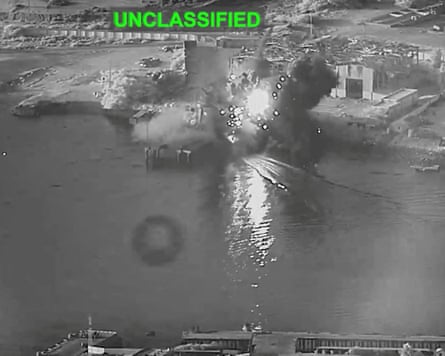
A statement read: “Any vessel suspected of entering or departing the blockaded area without authorisation is subject to interception, diversion and capture. Noncompliant vessels may be legally compelled with force.” The centre said neutral transit through the strait of Hormuz heading to or from non-Iranian destinations will not be impeded.
It remains unclear in practical terms how easy it would be for the navy to do this.
Trump’s demand for a 20% tariff comes despite his administration’s previous insistence that no country should be allowed to charge fees for passages used for international navigation.
That stance was reiterated last month by the US secretary of state, Marco Rubio, who said: “No country is allowed to charge tolls or fees on an international waterway. That’s existing international law.”
Iran’s Islamic Revolutionary Guard Corps accused the US on Monday of jeopardising global oil and gas supplies by interfering in the strait, as Tehran threatened that any US moves would be “strongly contested”.
The IRGC spokesperson Hossein Mohebi said Washington had “seriously endangered the security of the world’s oil and gas supply and must be held accountable”, adding in a post on X that Tehran would “continue to exercise sovereignty over and management of the strait of Hormuz”.
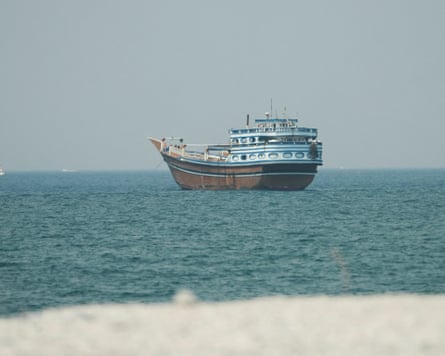
The International Maritime Organization, the UN agency that oversees safety and security measures in international shipping, said it was waiting to find out more about Trump’s proposal, but added: “We have always been consistent on our stance on fees – IMO stands firmly against charging fees for passage through straits used for international navigation. There is no legal basis through which to introduce mandatory tolls simply to transit through a strait.”
Trump said the US would probably take over the strait and should be reimbursed for controlling the waterway. “We’re going to keep the strait, and we’ll probably run it,” Trump said in a phone interview on Fox News.
Iran’s top negotiator, Mohammad Bagher Ghalibaf, posted on social media on Sunday: “The era of one-sided deals is OVER. We told you: keep your word or pay the price. Reality is knocking.”
The war has spread across the region, with Iran attacking US bases in multiple countries. Thousands of people have been killed, mainly in Iran and Lebanon.
Iran’s strikes on Sunday extended to Qatar, a mediator in ceasefire talks that had not come under attack since April. The United Arab Emirates, which had not been targeted since early May, said its air defences had engaged missiles and drones from Iran.
The conflict has caused global economic shock waves since it began in late February, driving energy prices higher and fuelling global inflation. Higher prices – especially for petrol – are politically sensitive for Trump in the run-up to November’s US congressional elections.
