



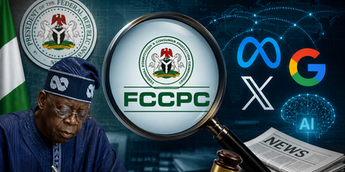
President Bola Tinubu has directed the Federal Competition and Consumer Protection Commission (FCCPC) to launch a comprehensive investigation into major global technology companies and Generative Artificial Intelligence (AI) platforms over allegations of anti-competitive practices, unlawful exploitation of Nigerian news content, and other potentially unfair market conduct against media organisations.
The directive follows a joint petition submitted to the Presidency by the Nigerian Press Organisation (NPO), an umbrella body comprising the Newspaper Proprietors’ Association of Nigeria (NPAN), the Nigeria Union of Journalists (NUJ), the Broadcasting Organisations of Nigeria (BON), and the Guild of Corporate Online Publishers (GOCOP).
The development was disclosed in a statement released on Monday and signed by the FCCPC’s Director of Corporate Affairs, Ondaje Ijagwu.
According to the statement, the Federal Government formally communicated President Tinubu’s directive to the Commission through a letter signed by the Minister of Information and National Orientation, Mohammed Idris.
The FCCPC said the investigation would focus on allegations that some of the world’s biggest technology companies, including Meta, Alphabet (Google), X (formerly Twitter), as well as certain Generative AI platforms operating in Nigeria, have engaged in practices capable of undermining fair competition, threatening the commercial sustainability of Nigerian media organisations, and violating the rights of content creators and publishers.
The Commission noted that the investigation marks a significant development in Nigeria’s media landscape as concerns continue to mount over the growing influence of global digital platforms on the country’s news ecosystem.
According to the statement, Nigerian media organisations have increasingly expressed concern over the unfair commercial advantage enjoyed by global technology companies through the use of locally produced journalistic content without adequate compensation or negotiated commercial arrangements.
Reacting to the directive, the Executive Vice Chairman and Chief Executive Officer of the FCCPC, Tunji Bello, assured stakeholders that the Commission would conduct an independent, transparent and evidence-based investigation.
“We recognise the strategic importance of the media to Nigeria’s democracy and the equally significant role of technology in driving innovation and economic growth. Our responsibility is to objectively determine the facts and ensure that competition within the digital ecosystem remains fair, transparent, and consistent with Nigerian law,” Bello said.
He stressed that the investigation should not be interpreted as a declaration of guilt against any of the companies involved.
“This inquiry is not directed at any entity by presumption of wrongdoing. Rather, it is an opportunity to carefully examine the facts, hear from all affected parties, and determine whether any conduct has resulted in anti-competitive outcomes or unfair business practices. Every party will be accorded a fair opportunity to present relevant information before any conclusions are reached,” he added.
The FCCPC said the investigation would determine whether the practices complained of amount to violations of the Federal Competition and Consumer Protection Act (FCCPA) 2018 or any other applicable Nigerian law.
Among the issues to be investigated are allegations of abuse of market dominance and anti-competitive conduct by the technology companies.
The Commission will also examine claims of unauthorised extraction, scraping, ingestion and commercial utilisation of copyrighted news articles, broadcast materials and other original journalistic content for the development and training of Generative Artificial Intelligence models.
Another major area of concern is the absence of equitable commercial relationships between global technology companies and Nigerian news publishers.
According to the FCCPC, central to the complaints is the allegation that Nigerian media organisations have been denied meaningful opportunities to negotiate fair compensation or enter into appropriate commercial agreements for the use of their journalistic content by the technology companies.
The Commission recalled that it had previously investigated Meta and, in 2025, secured a landmark legal victory against the social media giant over violations of the Federal Competition and Consumer Protection Act, including data privacy breaches.
Following that judgment, Meta was fined 220 million dollars, although the company has since appealed the decision.
The FCCPC further noted that similar concerns had previously been raised by media organisations in South Africa, leading to an investigation by the South African Competition Commission.
According to the Commission, the process eventually resulted in an agreement under which Google committed to compensate South African news media with R688 million (approximately 40 million dollars) annually for a period of three to five years
