


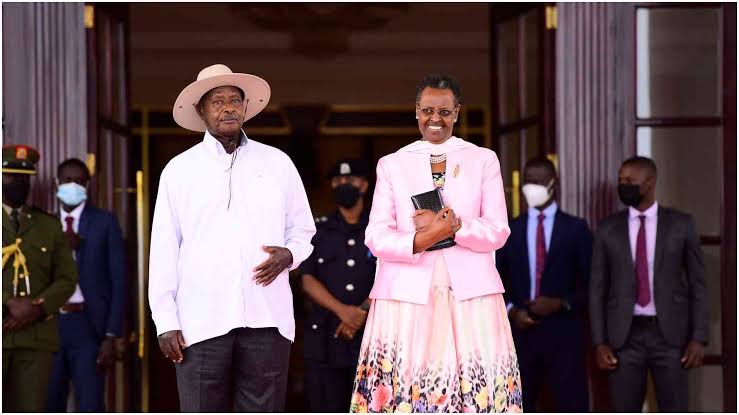
In a stunning and unprecedented gesture, Ugandan President Yoweri Museveni and First Lady Janet Museveni have publicly apologized to the Buganda Kingdom and all Ugandans for mistakes made during their nearly four-decade leadership. Delivered on May 25, 2025, during the Light Up Uganda for Jesus Mission Convention at Kololo Independence Grounds, the joint apology acknowledges governance failures, particularly toward Buganda, and seeks forgiveness as the nation approaches the 2026 elections.
Speaking at the spiritual gathering hosted by their daughter, Pastor Patience Rwabwogo, the Musevenis expressed remorse for “laxity, negligence, and lack of diligence” that left many, especially Buganda’s grassroots supporters, feeling “angry, neglected, or forgotten.” President Museveni, who has led Uganda since 1986, and First Lady Janet, the Education Minister, read a prepared prayer, stating, “We humbly take responsibility for all the mistakes made by ourselves, our agents, and representatives. We stand here to repent and ask for your forgiveness, especially the people of Buganda, and the whole country.” The apology, framed as a spiritual plea for national restoration, marks a rare moment of humility for the long-serving leader.
The apology’s focus on Buganda, Uganda’s largest ethnic group and a historically influential kingdom, addresses longstanding tensions. Buganda played a pivotal role in Museveni’s 1981-1986 bush war, providing support that helped his National Resistance Movement (NRM) seize power. However, relations have soured over issues like the government’s delay in returning kingdom properties promised during the war, clashes over land rights, and the violent 2009 riots sparked by Museveni’s refusal to allow Kabaka Muwenda Mutebi to visit Kayunga district, which left over 40 dead. The NRM’s 2021 electoral loss in Buganda to the National Unity Platform (NUP) underscored the kingdom’s shifting allegiance, making the apology a strategic outreach.
The apology has elicited a spectrum of responses. Some Ugandans view it as a sincere step toward reconciliation, with supporters praising Museveni’s acknowledgment of failures. Others, including opposition figures, dismiss it as a calculated move to regain Buganda’s support ahead of the 2026 elections. Hajj Abdul Nadduli, Museveni’s senior advisor on Buganda affairs, demanded action, stating, “If he wants Ugandans to accept his apology, he must release all political prisoners.” Critics argue that without concrete steps—like addressing land disputes or freeing detained opposition members—the apology risks ringing hollow.
The Musevenis’ apology comes at a critical juncture, with Uganda navigating economic challenges, a recent $12 trillion gold ore discovery, and rising opposition pressure. Buganda’s cultural and political weight makes its goodwill essential for the NRM’s electoral prospects. The apology could pave the way for dialogue with the kingdom, though Buganda spokesperson Israel Kazibwe cautiously welcomed it, noting unmet expectations. As Museveni’s 39-year rule faces scrutiny, the gesture reflects an attempt to mend ties and restore the NRM’s original vision of unity and transformation.
President Yoweri Museveni and First Lady Janet Museveni’s public apology to Buganda and Ugandans for four decades of governance missteps is a historic moment, blending spiritual repentance with political strategy. While it acknowledges deep-seated grievances, particularly in Buganda, its impact hinges on whether actions follow words. As Uganda looks toward 2026, the apology sets the stage for a critical reckoning with the past and a test of Museveni’s commitment to national healing.
Juba Global News Network will continue to monitor reactions to the Musevenis’ apology and its implications for Uganda’s political landscape, providing updates as this story develops.
