



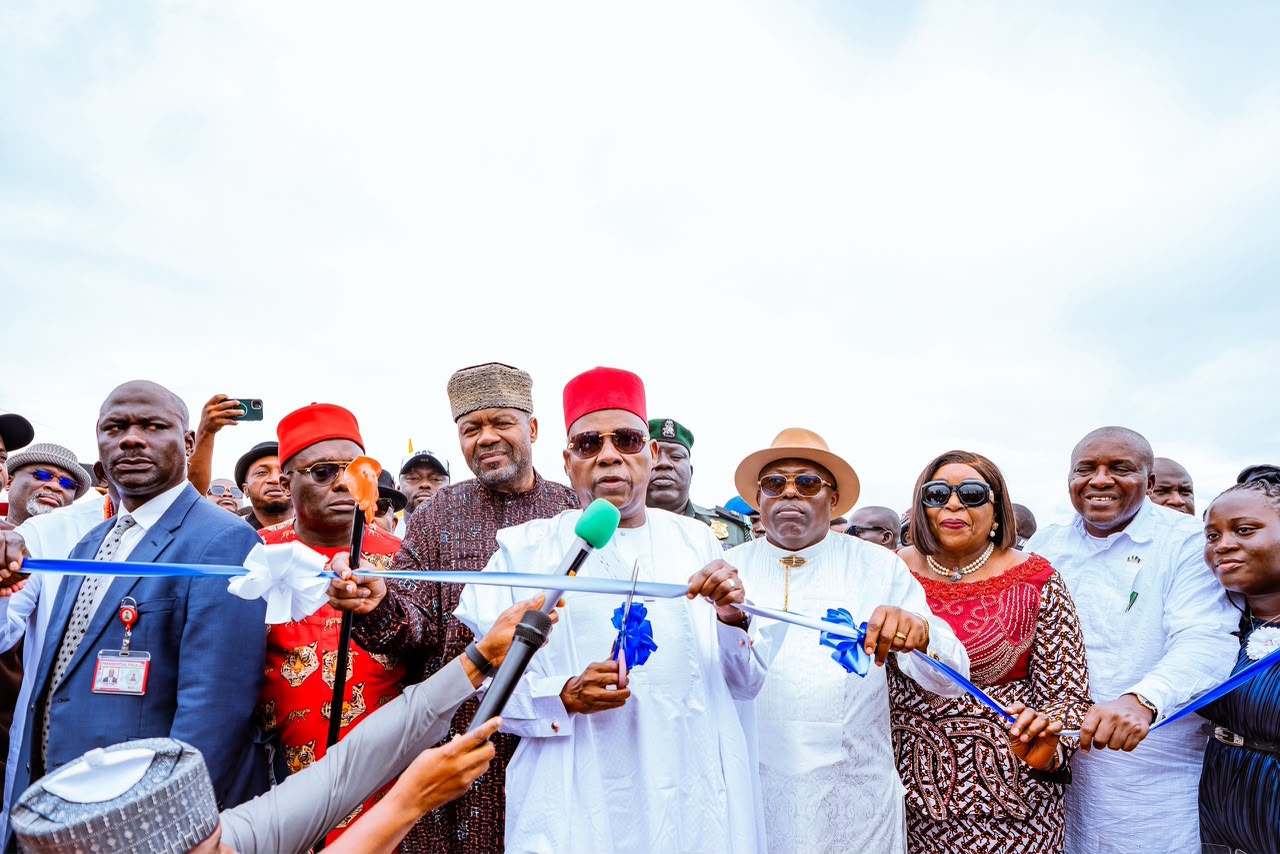
Vice President Kashim Shettima and Rivers State Governor, Sir Siminalayi Fubara, on Thursday commissioned the newly constructed 33.5-kilometre Elele-Egbeda-Omoku dual carriageway, a project described as a major boost to transportation, security and economic activities in the state.
The road, which traverses Ikwerre, Emohua and Ogba-Egbema-Ndoni Local Government Areas, provides a strategic link between several communities and is expected to ease the movement of people, goods and services across the affected areas.
Speaking at the commissioning ceremony, Shettima described the project as a demonstration of the commitment of the Rivers State Government to expanding the nation’s road infrastructure and creating an enabling environment for economic growth.
He said roads remained among the most important instruments of development because they connect farmers to markets, traders to customers, workers to places of employment, students to schools and patients to healthcare facilities.
According to him, the Elele-Omoku route had previously become a source of concern to commuters due to deep gullies, poor road conditions and security challenges, making journeys along the corridor difficult and hazardous.
Shettima commended Governor Fubara for transforming the previously deplorable route into a modern dual carriageway equipped with street lighting to enhance safety and movement both during the day and at night.
He said the project had not only improved transportation but also demonstrated how infrastructure development at the subnational level could contribute to broader national economic development.
Fubara, in his address, said the completion of the Elele-Omoku road had transformed a corridor previously associated with prolonged travel time, insecurity and economic losses into a modern and secure highway.
The governor described the project as one of the signature achievements of his administration and a fulfilment of its commitment to improving the welfare of Rivers people.
“For anybody who understands the nature of this road, they will appreciate what we have done here. It’s not just a project; it’s a statement that we have made to show our people that we care for you,” Fubara said.
He explained that the corridor had previously been notorious for kidnapping and illegal bunkering activities, expressing confidence that the improved road infrastructure would make such criminal activities more difficult.
“We already know what normally happens on this road. It is a corridor for kidnap; it is also a very big corridor for bunkering. I’m very, very convinced that with what we have done today, those things will be things of the past. Security agencies can now operate effectively along this corridor,” he said.
Fubara also commended communities along the route for their support and cooperation throughout the execution of the project.
He expressed particular appreciation for the presence of the Vice President at the commissioning, describing it as a demonstration that Rivers State remained an integral part of Nigeria and that the Federal Government was standing with the state.
“For a long time, I felt that maybe, we’re not part of this country. But today, I feel very happy that our country is also standing by us. I feel happy and fulfilled that even in the face of all our trials, in the face of all the ordeals that befell this administration, there are still positive things that people can see and look at and say: ‘Yes, you meant well for the people,’” he said.
Earlier, the Rivers State Commissioner for Works, Prof. Temple Nwofor, said the project was executed in line with approved engineering standards and specifications to guarantee its durability and structural integrity.
Nwofor disclosed that the contract was awarded to Messrs Craneburg Construction Company on March 26, 2024.
He said the project included approximately 33.5 kilometres of road construction and rehabilitation, six kilometres of drainage, a 99-metre-long and 11-metre-wide bridge at the Ubimini axis, as well as street lighting along the entire length of the highway.
According to him, each carriageway has a width of 7.3 metres, with a 50mm asphaltic binder course, 50mm asphaltic wearing course, 1.2-metre concrete shoulders on both sides and a 1.4-metre concrete median.
Nwofor said the project represented another significant milestone in the state government’s determination to provide durable infrastructure capable of improving connectivity and stimulating economic activities across Rivers State
