



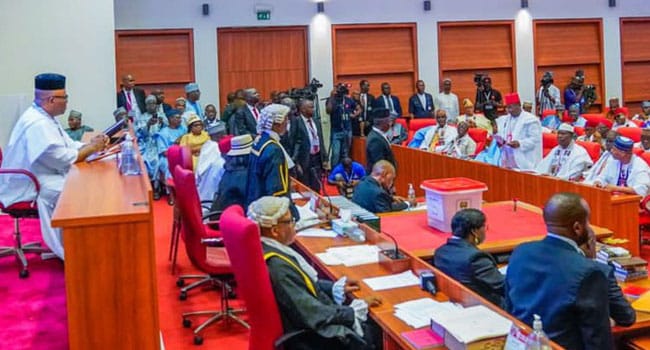
The Nigerian Senate has officially commenced a legislative process to alter the 1999 Constitution, seeking a revision of the national revenue allocation formula to grant the Federal Government a larger share of the Federation Account.
The initiative was formalized following the first reading of a bill sponsored by Senator Sunday Karimi (APC, Kogi West) during Tuesday’s plenary session. The bill aims to recalibrate the distribution of national wealth to better align with the expanding security and infrastructural mandates of the central government.
In a media briefing after the plenary, Senator Karimi emphasized that the existing revenue-sharing framework has become “outdated and unsustainable.” Under the current formula, the Federal Government receives 52.68%, while the 36 States and 774 Local Government Councils receive 26.72% and 20.60% respectively.
Despite holding the majority share, Karimi argued that the Federal Government is currently “suffocating” under the weight of responsibilities that far exceed its financial capacity.
“The proposed alteration seeks to increase Federal Government revenue allocation to address mounting financial obligations and national responsibilities across Nigeria,” Karimi stated. “The current formula places excessive pressure on the center amid rising infrastructure decay and nationwide insecurity.”
The Senate highlighted several critical areas where current funding levels are falling short:
National Security: The military requires significantly more resources to effectively combat banditry, terrorism, and other internal security threats.
Infrastructure Decay: The “Trunk A” federal road network across the country has deteriorated significantly, and the cost of rehabilitation has outpaced available budgets.
Fiscal Realism: The bill asserts that a “slight increase” is necessary to ensure the Federal Government can meet its constitutional obligations without accruing unsustainable debt.
The bill is expected to proceed to a second reading, where the specific percentages of the proposed upward review will be debated. As a constitutional amendment, the bill will eventually require the concurrence of the House of Representatives and approval by two-thirds of the State Houses of Assembly.
The Senate maintains that this adjustment is a strategic move to ensure the stability and functionality of the Nigerian state in the face of modern economic and security challenges
