


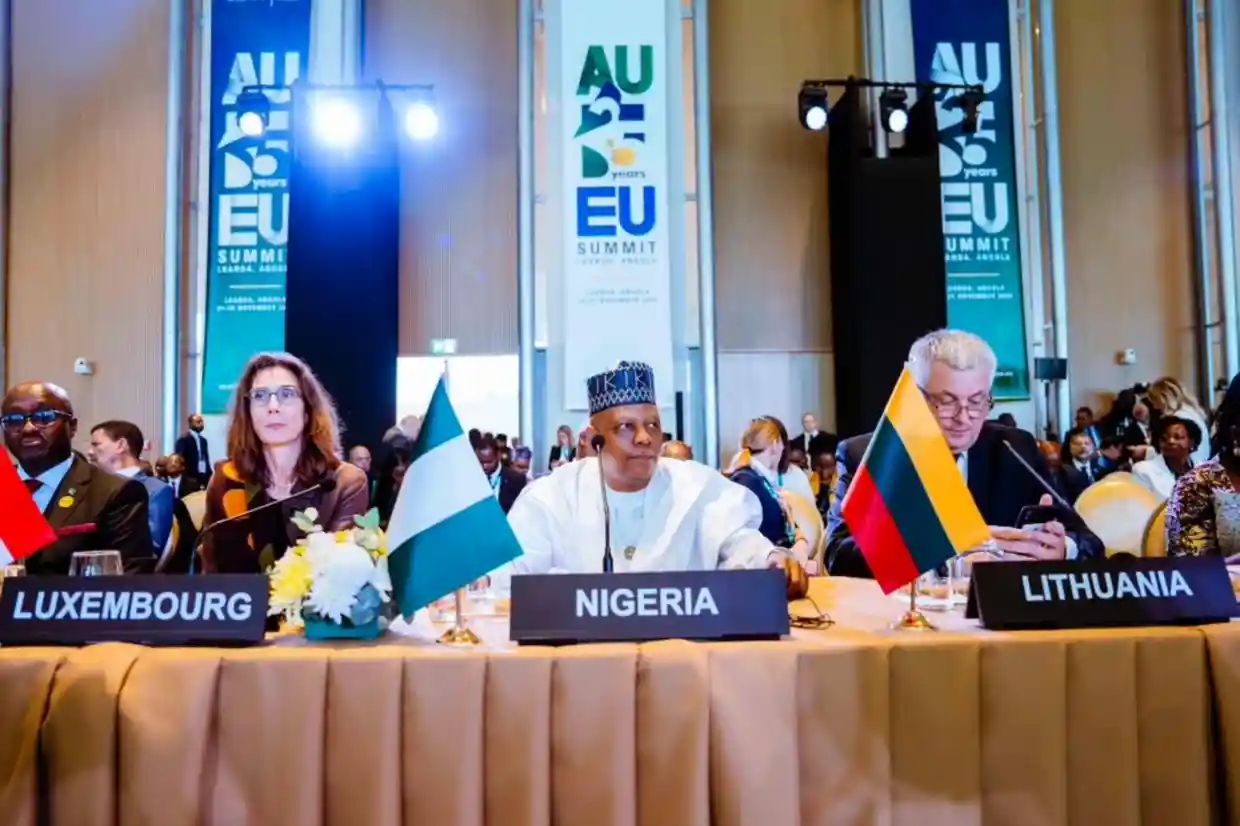
Nigeria has intensified its diplomatic push for Africa to secure permanent, veto-wielding seats on the United Nations (UN) Security Council, insisting that global governance reform is long overdue.
President Bola Tinubu made the call on Monday in Luanda, Angola, during the first plenary session on Peace, Security, Governance and Multilateralism at the 7th African Union–European Union (AU–EU) Summit. He was represented by Vice President Kashim Shettima.
President Tinubu urged the European Union (EU) to partner with Africa in designing peace and security solutions rooted in African-led frameworks, insisting that such cooperation is essential for sustainable stability.
He said; “It is time for Africa to occupy permanent seats on the UN Security Council, with all attendant privileges, including the veto.
“Genuine text-based negotiations under the Inter-governmental Negotiations (IGN) framework must now commence. We hope EU Member States will support Africa’s long-standing and legitimate call for reform.”
Security Gains and Regional Stability
President Tinubu highlighted Nigeria’s recent security achievements, including the surrender of over 120,000 Boko Haram-affiliated individuals, a development he attributed to a mix of kinetic and non-kinetic strategies.
He praised the role of the Multinational Joint Task Force (MNJTF) in the Lake Chad Basin, describing it as a model for African-led cooperative security initiatives.
The Nigerian leader also cited the recent Sea-Lift Agreement between the Nigerian Navy and the African Union Standby Force (ASF) as further proof of Nigeria’s commitment to regional peacekeeping capabilities.
President Tinubu warned that unaddressed regional instability fuels terrorism, insurgency, banditry and transnational organised crime.
He called for strengthened AU–EU collaboration in preventive diplomacy, inclusive governance, and long-term investments in people and infrastructure.
Migration
On irregular migration, President Tinubu advised that the issue must be approached from a balanced, developmental perspective.
“Criminalising mobility has only compounded insecurity across the continent and beyond,” he stated.
The President proposed structured labour mobility pathways, including Nigeria’s Technical Aid Corps and expanded Business Process Outsourcing (BPO) channels, enabling Africa’s youthful workforce to contribute to Europe’s labour needs without resorting to risky migration routes.
He said; “Seasonal mobility has underpinned West African civilisation for centuries.
“Our joint task is to convert mobility into safe, orderly, and productive pathways.”
Condemning Coups
President Tinubu strongly condemned the resurgence of Unconstitutional Changes of Government (UCGs) in Africa, noting that such disruptions undermine the African Union’s democratic foundations.
He linked the rise in coups to both internal fragility and “exogenous pressures that distort political balances.”
Nigeria, he said, has partnered with neighbouring countries to establish the Regional Partnership for Democracy (RPD)—an initiative aimed at strengthening constitutional order, countering extremist narratives, combating disinformation, and supporting governance reforms across West Africa.
President Tinubu also expressed concern over ongoing conflicts in Sudan and South Sudan, urging stronger international accountability for external actors fueling violence.
Peace interventions
The President reiterated that peace and security interventions in Africa must be African-led and implemented through legitimate regional mechanisms.
“Nigeria remains firmly committed to advancing peace, security, and democratic governance across the continent,” he said, pledging strengthened cooperation with the EU to build a more stable and prosperous world.
President Tinubu expressed appreciation to Angola for hosting the summit and thanked the EU for its longstanding support to Africa, particularly in the peace and security sectors.
