



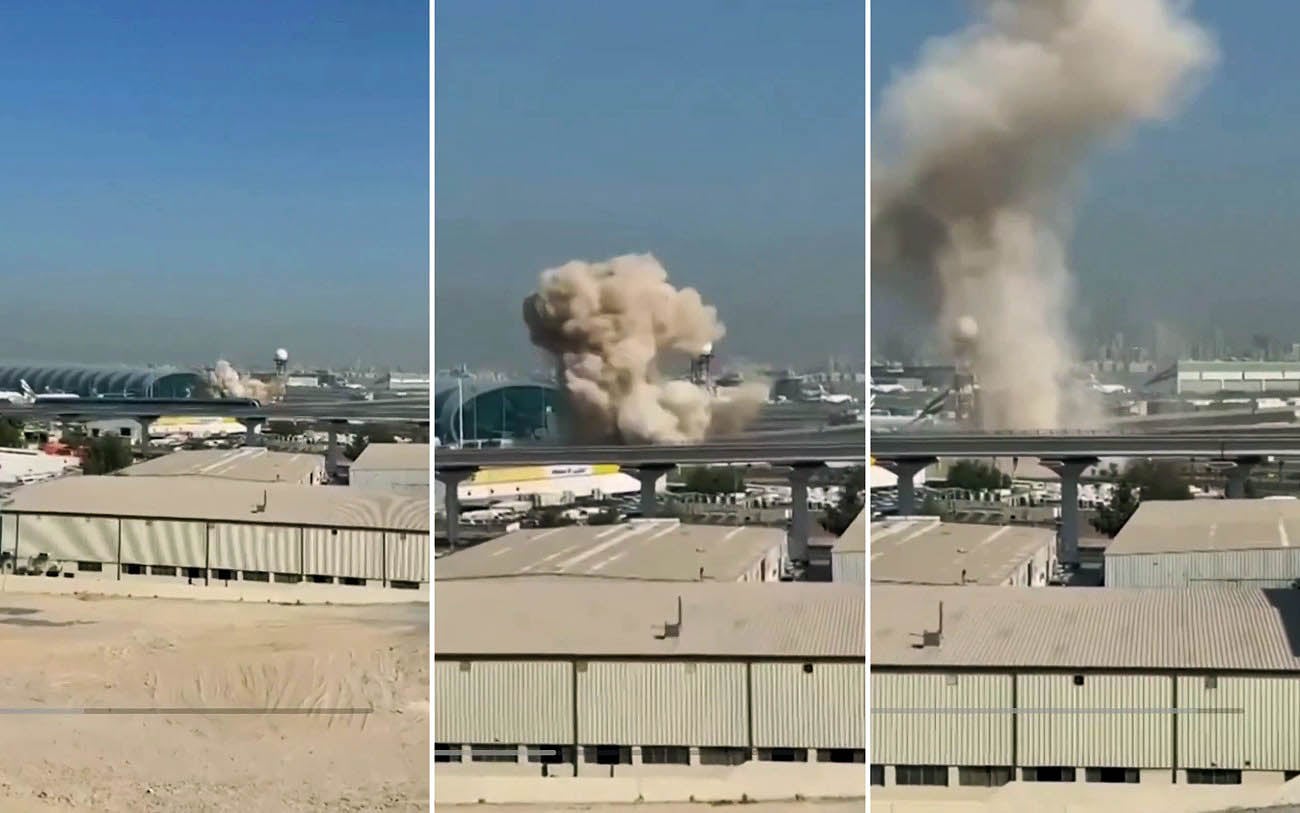
Dubai’s main airport, a key global transport hub, was forced to briefly close on Saturday, March 7, as Iran launched missiles and drones at targets across the Gulf. The barrage came despite Iran’s president apologizing to neighboring countries for its attacks, saying they would no longer be targeted unless strikes were launched from their territory. Attacks were reported on Saturday in the United Arab Emirates, Saudi Arabia, Qatar and Kuwait, where the national oil company announced a “precautionary” cut to production. The Emirates said it was targeted with 16 ballistic missiles and more than 120 drones.
One unidentified object was intercepted near Dubai airport, the world’s busiest for international traffic, forcing it to briefly suspend operations. A witness told Agence France-Presse (AFP) of a loud explosion in the area followed by a cloud of smoke, while footage authenticated by AFP recorded the sound of a drone followed by a loud explosion and plumes of smoke close to an airport concourse.
The government said there had been “a minor incident resulting from the fall of debris after an interception,” without directly mentioning the airport. It said there were no injuries. The Flightradar24 tracking website earlier showed planes circling above the airport in an apparent holding pattern. In a statement since deleted from X, Emirates, the largest airline in the Middle East, had announced it was suspending all flights to and from Dubai until further notice, but later said it had resumed operations.
The UAE, a US ally and home to American military installations, has been the most heavily targeted nation in the Gulf during the war. The Ministry of Defense said that of the 16 ballistic missiles fired at the country on Saturday, all but one had been intercepted, with that missile falling into the sea. Of the 121 drones detected, 119 were brought down, while two fell within Emirati territory. The barrage brings the number of ballistic missiles detected by the UAE since the start of the war last Saturday to 221, the Defense Ministry said, with the number of drones surpassing 1,300.
Flights from Dubai’s main airport had partially resumed on Monday despite daily drone attacks targeting sites in the UAE. Last Saturday, four employees were injured and an airport terminal was damaged as the war broke out following US-Israeli strikes on Iran. Operator Dubai Airports said at the time that the incident had been “quickly brought under control,” without providing details.
Iranian attacks have also hit Abu Dhabi airport, the upmarket Palm Jumeirah development and the Burj Al Arab luxury hotel over the past week, while drone debris caused a fire at the US consulate in Dubai on Tuesday. Elsewhere in the Gulf on Saturday, Qatar’s Defense Ministry said its military had intercepted a missile attack targeting the country, without elaborating. In Saudi Arabia, the Defense Ministry said it had destroyed three ballistic missiles heading toward Prince Sultan Air Base, which hosts American troops, as well as 17 drones over the Shaybah oil field in the southeast.
Kuwait also reported intercepting a drone, while the country’s national oil company announced a “precautionary” cut to its production of crude due to Iranian attacks and threats to the Strait of Hormuz, a key transit point for Gulf hydrocarbons. Further north, Jordan accused Iran of directly targeting sites in the kingdom, saying Tehran had fired 119 missiles and drones in the past week. “These missiles and drones were targeting vital installations inside Jordan and w
