



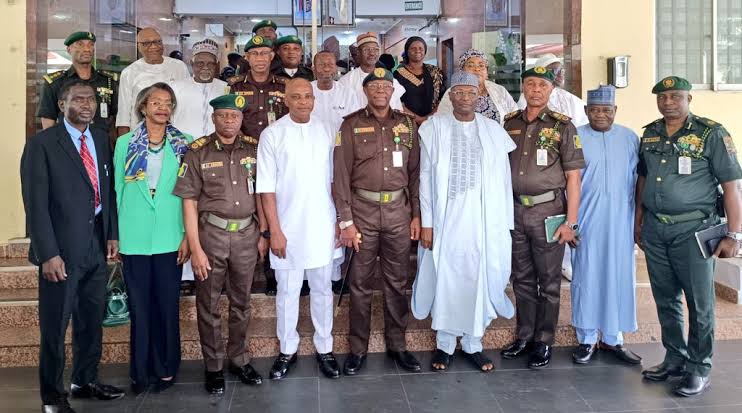
The Independent National Electoral Commission (INEC) says it is working with the Nigeria Correctional Service (NCoS) on the voting right of inmates.
INEC Chairman, Mahmood Yakubu, disclosed this on Friday while receiving the Comptroller General of NCoS, Sylvester Nwakuche, at the Commission’s Headquarters in Abuja.
Yakubu affirmed the judgement of the Appeal Court, granting inmates the right to register and vote in any elections.
“We are aware that the right to vote is a human right which cannot be taken away from a citizen on account of time being served in a correctional facility. In many parts of the world, including some African countries such as Ghana, Kenya, and South Africa, where our officials observed elections, inmates exercised the right to vote,” Yakubu said.
“As you are aware, an election is a process governed by law. Working together, we can seize the opportunity of the ongoing electoral reform for a clear legal provision that will specifically cover citizens serving time in our correctional facilities.”
“Working together, we can seize the opportunity of ongoing electoral reform for a clear legal provision that will specifically cover citizens serving time in our correctional facilities,” Yakubu said. “Our immediate task is to engage with the National Assembly for clarity and legal backing.”
He referenced a series of meetings the Commission had with the service, to work out modalities for accommodating affected inmates, which include access to facilities, and political parties’ concerns, as well as clarifications for the category of inmates the judgement favour.
The INEC chairman re-echoed the need to seek the intervention of the National Assembly on the matter.
He assured the service of the commission’s determination to allow inmates to vote in any election, provided it is done following existing laws.
“The Commission is aware of the judgements of the Federal High Court in Benin delivered on 16th December 2014 and the Court of Appeal, also in Benin, delivered on 7th December 2018 pertaining to the right to vote by five plaintiffs awaiting trial,” the INEC chairman told the gathering.
“Based on the combined provisions of Article 25 of the International Convention on Civil and Political Rights (1966) and Section 25 of the Constitution of the Federal Republic of Nigeria 1999 (as amended) on citizenship, the court affirmed the rights of plaintiffs who were inmates awaiting trial to vote in elections.
“However, the judges ruled that the right to vote is only excisable when asserted, as it is a choice to be exercised voluntarily by a citizen and not a duty to be imposed by force of authority.
“You may recall that in recognition of this situation, the Commission had several discussions with the correctional service on how inmates who wish to register and vote in elections can do so.
“We even set up a joint technical committee to review all the issues involved and advise on the way forward. You availed us with data on the locations and types of federal correctional facilities nationwide. You also provided us with statistics on the various categories of inmates, the majority of whom are on remand awaiting trial and who may actually be registered voters.
“For our part, we raised the issue of access to the correctional facilities for voter registration, creation of polling units, and voter education. On behalf of stakeholders and for transparency, we also brought to your attention concerns about access to your facilities for observers and the media. Political parties also want to know if they will be allowed to campaign in the correctional facilities and appoint polling agents on election day. We believe that working together with you and the stakeholders, we can address these concerns.
“Doing so will also clarify the provision of Section 12(1)[e] of the Electoral Act 2022 on voter registration, a precondition for voting in elections, which restricts the exercise to a Nigerian citizen who ‘is not subject to any legal incapacity to vote under any law, rule or regulations in force in Nigeria’. There are various interpretations as to whether this provision relates to inmates on death row, those serving life sentences, or those convicted of treason.
“Our immediate task is to engage with the National Assembly for a clear legal provision on inmate voting. Thereafter, we can address the specific issues that may arise in the course of implementation.”
Yakubu’s comments followed Nwakuche’s case for the electoral body to extend some rights to prison inmates, particularly the right to vote.
According to him, there are over 81,000 inmates across the correctional centres, and about 66 percent of them are awaiting trials.
The Comptroller General also cited a recent court ruling that upheld the rights of inmates, especially those who are awaiting trials, to vote in an election.
In 2019, the Court of Appeal sitting in Benin, Edo State, affirmed the right of inmates across the country to vote.
The decision followed an appeal filed by five inmates on behalf of other inmates in Nigerian prisons to direct INEC to include their names in the voter register.
The court, however, refused to grant a request that INEC should liaise with the Nigerian Prisons Service to create registration centres at various prisons across the country
