



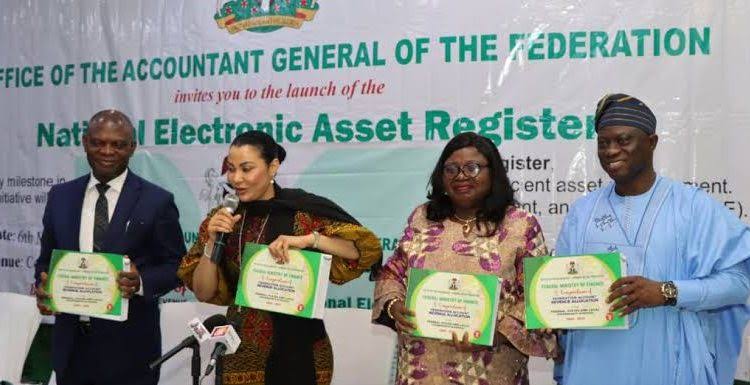
The Nigerian government has launched the National Electronic Asset Register to strengthen transparency and accountability across the Ministries Departments and Agencies (MDAs) of government.
In addition to the launch, the Office of the Accountant General of the Federation (OAGF) unveiled a compendium of federation Account revenue allocation to all three tiers of government, comprising the federal, state and 774 local government councils from 2020 to 2023.
Unveiling the two documents, the Minister of State for Finance, Dr. Doris Uzoka-Anite, described the two documents as strategic and important to government business.
The Minister referred to the Electronic Asset Register as a balance sheet of government, which must document every single asset belonging to the government.
“Any entity, whether it’s a public entity or private entity, must have a balance sheet”, said the Minister, and he lauded the Accountant General of the Federation, Mrs Oluwatoyin Madein, for bringing the two projects to fruition in marking her retirement from government service.
In her opening remarks as Account General of the Federation (AGF), Mrs Oluwatoyin Madein, who is billed for retirement this (Friday), said the national electronic asset register would increase transparency and accountability.
”Assets are the backbone of any economy, for any government, public assets are a significant part of its balance sheet, influencing not just the financial position but also its ability to deliver services to the citizens.
”The importance of transparency in asset management cannot be overstated. It ensures that we know what assets we own, where they are located and how they are used. This is not just an accounting exercise but a matter of public trust,” she said.
Madein said that the national electronic asset register was designed to give real-time access to information about the assets owned by the Federal Government.
She said that the digital registry would increase transparency and would serve as a central point where the public, policy makers and government can access and track the nation’s assets.
”By doing this, we are fostering greater accountability which is essential to prevent mismanagement, fraud and corruption.
”When citizens can see how public assets are being managed, they can hold their government accountable. Whether it is infrastructure, equipment or other forms of public property, every asset must be accounted for.
”The register is a step toward ensuring that the government’s assets are being put to the best use for the benefit of the Nigerian people,” Madein said.
According to her, the national electronic asset register would improve public financial management, it would enable the Federal Government to track and manage its Property, Plant and Equipment (PPE) effectively.
She said the initiative would secure the future, it would help understand the long-term value of our asset and plan for their maintenance, replacement or disposal that aligned with the national development goal.
Madein said that the launch was also a commitment to international standards.
She said that the Federal Government adopted the International Financial Reporting Standards (IFRS) and International Public Sector Accounting Standards (IPSAS) for public sector accounting would be supported by digital register.
”Unveiling of Compendium of Federation Account Revenue Allocation from 2020 to 2023 is a testament to our commitment to transparency and accountability is the management of our nation’s finances.
”It provides a detailed breakdown of the revenue allocation to the three tiers of government and serves as a vital tool for policymakers, researchers, students, national and state assemblies and the public.
”The constitution of the Federal Republic of Nigeria section 163 stipulates that all federally collected revenues should be paid into the Federation Account Allocation Committee (FAAC), at the monthly meeting,” Madein said
According to her, the compendium covers a period of four years and provides a comprehensive analysis of the revenue allocation of the Federal, state and Local governments
