



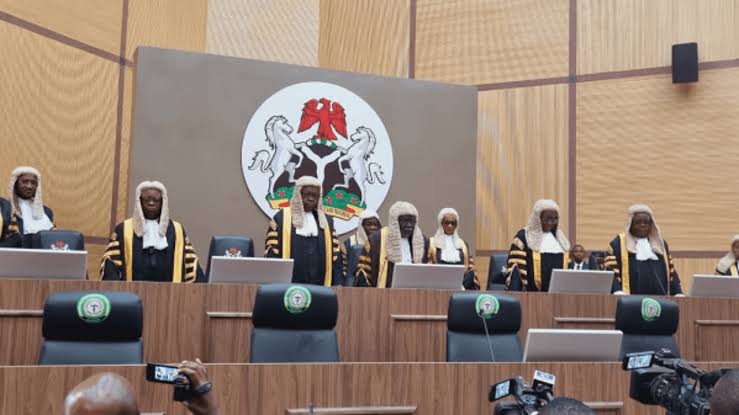
The Federal Government has presented its reasons to the Supreme Court for declaring a state of emergency in Rivers State, emphasizing the collapse of governance and attacks on critical national infrastructure as key factors. The government argued that it had no option but to intervene.
This submission was made in response to a lawsuit filed by 11 states, mostly governed by the opposition Peoples Democratic Party (PDP). These states include Adamawa, Akwa Ibom, Bauchi, Bayelsa, Delta, Enugu, Osun, Oyo, Plateau, Taraba, and Zamfara. The plaintiffs argue that the federal government’s decision to impose emergency rule on Rivers State was unlawful, but the Federal Government has rejected these claims.
In an affidavit filed by Taiye Hussain Oloyede, the Special Assistant to the President and the Federal Ministry of Justice, the Federal Government outlined the severe political crisis in Rivers State that led to the emergency declaration by President Bola Ahmed Tinubu on March 15, 2025. According to the government, critical state infrastructure, such as oil pipelines, became targets for vandalism, and militants made open threats against perceived enemies of the governor. The government also claims that Governor Similayi Fubara failed to take action to address these threats or to denounce the militants.
Additionally, the crisis escalated when Governor Fubara demolished the Rivers State House of Assembly complex, further deepening the political gridlock. It was also noted that only four members of the State Assembly were working with the governor, while 27 others were blocked from performing their duties, effectively depriving them of their constitutional right to make laws.
The Federal Government argues that the governor’s inability to present an Appropriation Bill to the House of Assembly caused governance to grind to a halt, leading to the necessity of an emergency intervention. The Governor’s failure to act, alongside the lack of coordination between the executive and legislative branches, resulted in the collapse of governance in the state.
The affidavit further describes how militants in Rivers were allowed to continue their threats without the governor intervening, while the state’s political situation deteriorated, with ongoing legal battles between the governor and lawmakers. These suits reached the Supreme Court, which ruled that there was effectively no government functioning in the state.
According to the Federal Government, despite President Tinubu’s attempts to mediate and resolve the crisis, the situation worsened, with no efforts made by the involved parties to reach an agreement. The government asserts that to prevent further deterioration and violence, the state of emergency was declared.
The Federal Government also rejects claims made by the plaintiffs that the emergency declaration threatens to extend to other states, stressing that President Tinubu acted within the bounds of the constitution. Furthermore, the government argued that the suit filed by the plaintiffs is speculative, and that the National Assembly should dismiss the case on the grounds of procedural flaws and lack of merit.
The PDP governors are asking the Supreme Court to determine the legality of the federal government’s actions under the constitution, specifically questioning whether the President can suspend state governors and legislative bodies during a state of emergency.
The National Assembly, which is also named in the suit, has urged the Supreme Court to dismiss the case, calling it a “frivolous and speculative suit.” They argue that the court lacks jurisdiction over the matter and has called for a penalty of N1 billion in costs
