



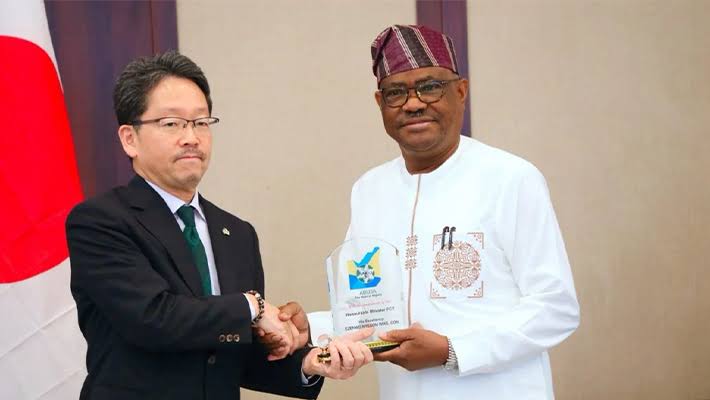
Nyesom Wike, minister of the Federal Capital Territory (FCT), says his administration will strengthen collaboration with the Japanese government to fast-track Abuja’s development in line with its master plan.
Wike spoke during the visit of Suzuki Hideo, Japanese ambassador to Nigeria, alongside officials of the Japan International Cooperation Agency (JICA).
The minister applauded the role of Japan in the development and review of the Abuja master plan, stressing its importance for long-term growth.
“You have contributed to education, health, nutrition, and other critical sectors that impact directly on our people,” he said.
“You have been working closely with the FCDA on the Abuja master plan. That is very key for us. We will continue to cooperate with you to ensure that this is actualised.”
The minister said Japan’s interventions in Nigeria’s education sector include training programmes for teachers and support for quality learning infrastructure.
According to him, “we have seen the support in education, including training of our teachers in Tokyo. This is very important to improve our education sector.”
Wike said agriculture and urban development are priority areas for future collaboration, while assuring the Japanese delegation that the FCT administration is ready to provide an enabling environment for sustained partnership.
“We will partner with you, particularly in agriculture and city development, to ensure that the Renewed Hope Agenda of Mr President becomes a reality,” he added.
While speaking, the Japanese ambassador reiterated the commitment of his country to Nigeria’s development.
He stressed that Abuja remains prominent to Nigeria’s progress in its status as the political and administrative capital.
He said Japan is advancing projects in waste management and industrial development, including a plastics value chain initiative in collaboration with the United Nations Industrial Development Organisation (UNIDO), with a pilot facility set for handover.
“The development of Abuja is crucial for driving Nigeria’s progress. Japan and JICA have been implementing various projects in infrastructure, healthcare, and economic development,” he said.
He stressed that there are ongoing efforts to upgrade the Abuja master plan through JICA and improve residents’ quality of life and support sustainable urban growth.
Ishigame Keiji, the chief representative of the JICA Nigeria office, noted that the interventions of the organisation in FCT cut across critical issues like water, power, health, agriculture, and education sectors.
He explained that the review of the 1979 master plan of Abuja, which focuses on infrastructure expansion, economic growth, and climate resilience, is being supported by JICA to align with the development needs of the city up to 2050.
Keiji stated that the agency is ready to move into priority infrastructure development immediately once the revised plan is completed, backed by its global experience in executing large-scale projects
