



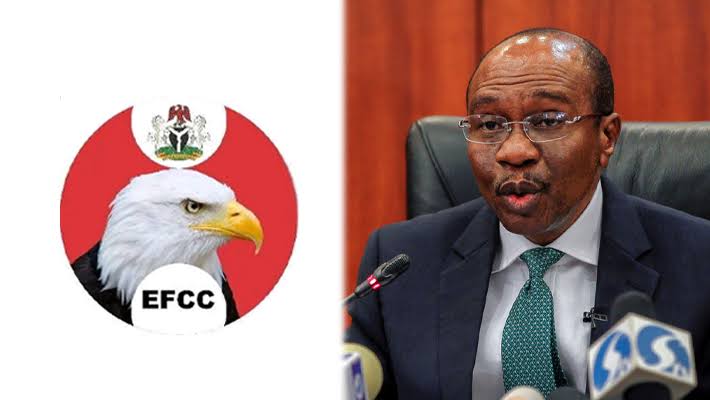
Nnamdi Offia, counsel to Henry Omoile, co-defendant of Godwin Emefiele, ex-governor of the Central Bank of Nigeria, has alleged that the Economic and Financial Crimes Commission (EFCC) asked his client to provide incriminating evidence against Emefiele.
Offia on Thursday appeared before the special offences court in Ikeja, Lagos, as the defence witness in the trial-within-trial of Omoile.
BACKGROUND
Emefiele is standing trial on a 19-count charge bordering on receiving gratification and corrupt demands as CBN governor.
Omoile is facing a three-count charge bordering on unlawful acceptance of gifts by a public officer.
One of the prosecution witnesses had previously told the court that he routinely collected dollars in cash from some individuals for Emefiele and handed them to Omoile on the orders of the ex-CBN governor.
During the trial on October 9, 2025, Rotimi Oyedepo, EFCC counsel, sought to tender Omoile’s extra-judicial statements as evidence.
However, Kotoye Adeyinka, counsel to Omoile, told the court that the statements were not voluntarily made.
Thereafter, Ramon Oshodi, the trial judge, ordered a trial-within-trial to ascertain whether the statements were made under duress.
In December 2025, Alvan Gurumnaan, an EFCC operative, said the agency did not compel Omoile to make statements.
PROCEEDINGS
At the resumption of hearing on Thursday, Offia told the court that EFCC investigators who questioned Omoile restricted him and did not allow him to express himself in line with the questions asked on February 26, 2024.
Offia said when his client was interrogated the next day, he was not in their office at the time.
He added that when he challenged the interrogation process, he was confronted by an EFCC officer identified as David.
The lawyer alleged that EFCC investigators promised his client bail and non-prosecution if he provided incriminating evidence against Emefiele.
“On several occasions, questions were put to the second defendant (Omoile), and he answered, but he was not allowed to write them down because the answer did not conform to what the interrogators wanted him to say. I objected to this many times,” he said.
“The sessions of 26 February 2024 ended with the investigative officers telling me they would be detaining him because they were not done with him.
“On February 27, 2024, I met the second defendant while being interrogated by the team, and I questioned why the interrogation was being conducted behind me.
“One David challenged me, asking what right I had to question the manner in which the questions were being taken from the defendant. Tempers rose, and David walked me out of the premises.
“I was taken aback and reported the incident to the head of the team, who told me not to worry and advised me to sit in the waiting area.
“I was not allowed to provide my services to my client until about 8pm, when he was taken back to the detention centre.
“Later, I was told that he had refused to cooperate with them, and they are not going to release him. It was at that point that I applied for the defendant’s bail to the zonal head of the EFCC.
“The defendant was detained for 21 days. I later filed a fundamental rights case at the federal high court in Lagos, and the judge, Justice Muslims Hamza, granted him bail but ordered that he be remanded in Ikoyi Correctional Centre until he perfects the bail conditions.”
During cross-examination by Oyedepo, the lawyer was asked if he complained or filed a petition against the alleged misconduct of the investigation team. He responded in the negative.
Offia told the court that the judge who heard the fundamental rights enforcement case did not find the EFCC guilty of any misconduct and that his client was never harassed in his presence.
Hearing in the case was adjourned to January 16
