



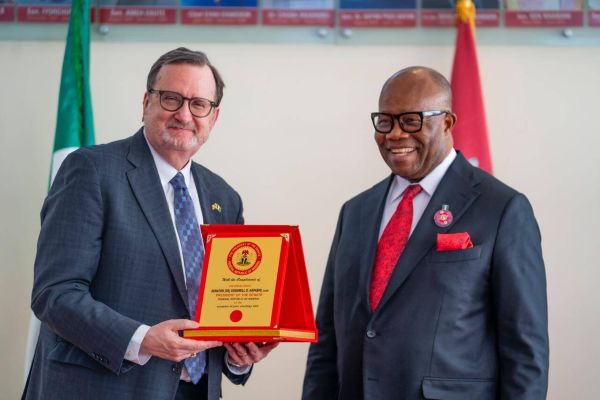
Senate President Godswill Akpabio, on Wednesday, received the US Ambassador to Nigeria, Richard Mills Jnr, stressing the need to strengthen the relations between the two countries.
The duo, who met at the National Assembly complex in Abuja, expressed their desire for a more robust diplomatic relationship between Nigeria and America.
Akpabio said that Nigeria and America had a shared goal of operating a democratic system, as the country’s democracy was modelled after the US system, and therefore the need to nurture and preserve it.
“I thank you for receiving me during the 249th Independence Anniversary of your country. I congratulate you. That means you have practised democracy for 249 years. We can’t say we have done the same in Nigeria,” Akpabio stated.
“The collaboration between our countries is there, and our democracy and system of government is modelled after the United States of America.
“One thing that I do know is that America has remained prosperous and has assisted many countries in the world because of the strong belief that: In God we trust.
“In Nigeria, despite our religious and ethnic diversities, we also believe that God is the greatest. So we share something in common. You are welcome to the 10th Senate of the Federal Republic of Nigeria.”
On his part, Ambassador Mills said the visit was aimed at reviewing the state of US-Nigeria relations and exploring ways to further strengthen cooperation between both nations.
According to him, the United States Mission would continue to engage with Nigeria in pursuit of shared democratic and development goals.
He said that the meeting also provided an opportunity to gain insight into the legislative priorities of the Nigerian Senate in the year ahead.
Recently, the United States government placed Nigeria on its watch list of “Countries of Particular Concern,” citing what it described as widespread persecution and killings of Christians — a move that sparked sharp diplomatic exchanges.
But the Nigerian authorities have since denied the allegation, arguing that the complex security challenges — including jihadist insurgency, banditry, and communal conflict — affect people of all faiths and are being mischaracterised as “Christian genocide.”
The Nigerian government also dismissed threats of punitive action or military intervention as baseless and potentially destabilising, urging foreign partners to respect the country’s sovereignty and work cooperatively to address violent extremism
