


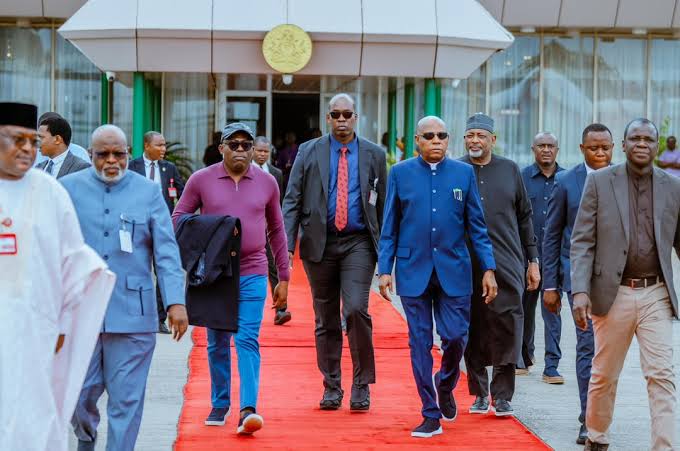
Vice President Kashim Shettima has arrived in New York, United States, to represent President Bola Ahmed Tinubu and lead Nigeria’s delegation to the 81st Session of the United Nations General Assembly, UNGA, with the Federal Government expected to use the high-level gathering to advance the country’s national interests and push for reforms of the global governance system.
Shettima, who arrived in New York on Monday, said Nigeria’s participation at the General Assembly would be guided by its national interest, commitment to multilateralism and President Tinubu’s advocacy for a more representative international system that reflects contemporary economic and demographic realities.
The Vice President said Nigeria would engage its international partners from the standpoint of its national interests while supporting reforms that would give developing countries, particularly African nations, a stronger voice in global decision-making. Blueprint reports
“Our message in New York is clear. Nigeria believes in multilateralism, but the institutions that govern our world must become more representative, equitable, and responsive to the realities of today,” Shettima said.
“We will engage our partners firmly from the standpoint of Nigeria’s national interest while advancing President Tinubu’s call for a global system that gives developing countries a stronger voice and a fairer opportunity to prosper.”
Shettima leads high-level delegation
The Vice President arrived in New York alongside Rivers State Governor Siminalayi Fubara, Minister of State for Budget and Economic Planning, Dr Doris Uzoka-Anite, and other senior government officials.
The wider Nigerian delegation includes Zamfara State Governor Dauda Lawal, while officials who received Shettima on arrival included Lagos State Governor Babajide Sanwo-Olu, Deputy Chief of Staff to the President, Office of the Vice President, Senator Ibrahim Hassan Hadejia, Minister of Foreign Affairs, Ambassador Bianca Odumegwu-Ojukwu, Minister of Women Affairs, Hajiya Imaan Sulaiman-Ibrahim, Minister of Solid Minerals Development, Chief Dele Alake, and Nigeria’s Permanent Representative to the United Nations, Ambassador Jimoh Ibrahim.
The composition of the delegation reflects the administration’s intention to combine diplomatic engagements with discussions on economic development, investment, international cooperation and issues affecting Nigeria and the wider African continent.
Nigeria to present national position
During the General Debate, Shettima is scheduled to deliver Nigeria’s national statement, outlining the country’s positions on major international issues affecting peace and security, economic growth, sustainable development and global cooperation.
Nigeria’s address will come against the backdrop of the theme of the 81st UN General Assembly, “Restoring trust, managing transformation: A United Nations that delivers for all.” The General Debate runs from September 22 to 28 at the UN headquarters in New York.
According to the Presidency, the Vice President’s engagements will include high-level meetings and bilateral discussions with foreign leaders, international organisations and development partners on the sidelines of the General Assembly.
The meetings are expected to provide opportunities for Nigeria to strengthen existing partnerships and pursue cooperation in areas considered important to its development priorities.
Among the issues expected to feature prominently are reform of the international financial architecture, sustainable development, climate finance, technology access and stronger African representation in global decision-making.
Nigeria’s position on reforming international institutions is not new. President Tinubu, represented by Shettima at the 18th BRICS Leaders’ Summit in New Delhi earlier this month, called for reforms of the United Nations Security Council and international financial institutions to make the global system more representative and responsive to present-day realities.
Tinubu’s global reform agenda
The administration has increasingly linked its foreign policy engagements to its economic reform programme at home, with officials arguing that Nigeria requires a more responsive international system to advance its development interests.
At the BRICS summit, Tinubu said Nigeria supported a more representative, equitable and responsive international order and called for deeper cooperation in areas including artificial intelligence, fintech, digital infrastructure, cybersecurity and biotechnology.
The President has also maintained that African countries should have greater influence in international institutions where decisions affecting their economies and populations are made.
That position is expected to form part of Nigeria’s diplomatic engagements in New York, particularly discussions around international financial institutions, development financing and Africa’s representation in global decision-making structures.
Earlier this year, United Nations Secretary-General António Guterres also held discussions with Shettima on Nigeria’s role in global and continental affairs and the need for stronger African representation in the international system. During the meeting, Shettima reiterated Nigeria’s call for comprehensive reform of the UN system and stronger African representation in global decision-making.
Economic diplomacy, climate finance on agenda
Beyond political and institutional reform, the Nigerian delegation is expected to focus on economic diplomacy and development financing.
The Federal Government is seeking stronger international partnerships in areas capable of supporting investment, infrastructure development, technology transfer and sustainable economic growth.
Climate finance is another significant issue, particularly as developing countries continue to press for increased access to financing to address the effects of climate change and support adaptation and sustainable development.
Nigeria is also expected to use its engagements to strengthen its case for greater access to technology and investment partnerships, particularly in emerging sectors capable of creating employment and expanding economic opportunities.
The administration has consistently presented economic diplomacy as an important component of its foreign policy, seeking to connect Nigeria’s international engagements with investment, trade and development opportunities at home.
Shettima to engage world leaders
Apart from delivering Nigeria’s national statement, Shettima will participate in a number of high-level meetings and bilateral engagements with foreign leaders, international organisations and development partners.
The engagements will provide the Vice President with an opportunity to discuss issues of mutual interest and strengthen Nigeria’s relationships with strategic partners.
The Presidency said the meetings would also be used to reinforce Nigeria’s positions on sustainable development, international financial reform, climate finance, technology access and the need for stronger African representation in global decision-making.
The Vice President is also expected to participate in events focused on issues of strategic importance to Nigeria and the African continent during the UNGA week. Recent reporting indicates that his programme includes high-level discussions on the Right to Development and climate action, among other issues.
Third consecutive UNGA for Shettima
Shettima’s participation also marks the third consecutive UN General Assembly at which he has represented President Tinubu.
Tinubu personally attended the 78th UNGA in 2023, shortly after assuming office, but did not attend the 79th session in 2024 or the 80th session in 2025, with Shettima representing him on both occasions. The Vice President is therefore again leading Nigeria’s delegation at the 81st session.
The Presidency has said the President’s absence does not diminish Nigeria’s diplomatic role, while Shettima’s participation ensures that the country remains represented at the annual gathering of the 193 UN member states.
For Nigeria, the UNGA provides an important platform for presenting national priorities, engaging development partners and participating in discussions on issues that transcend national borders.
As the General Debate begins, the Nigerian delegation is expected to use the week-long programme to pursue diplomatic, economic and development objectives, while reinforcing the administration’s call for a more representative global governance structure
