



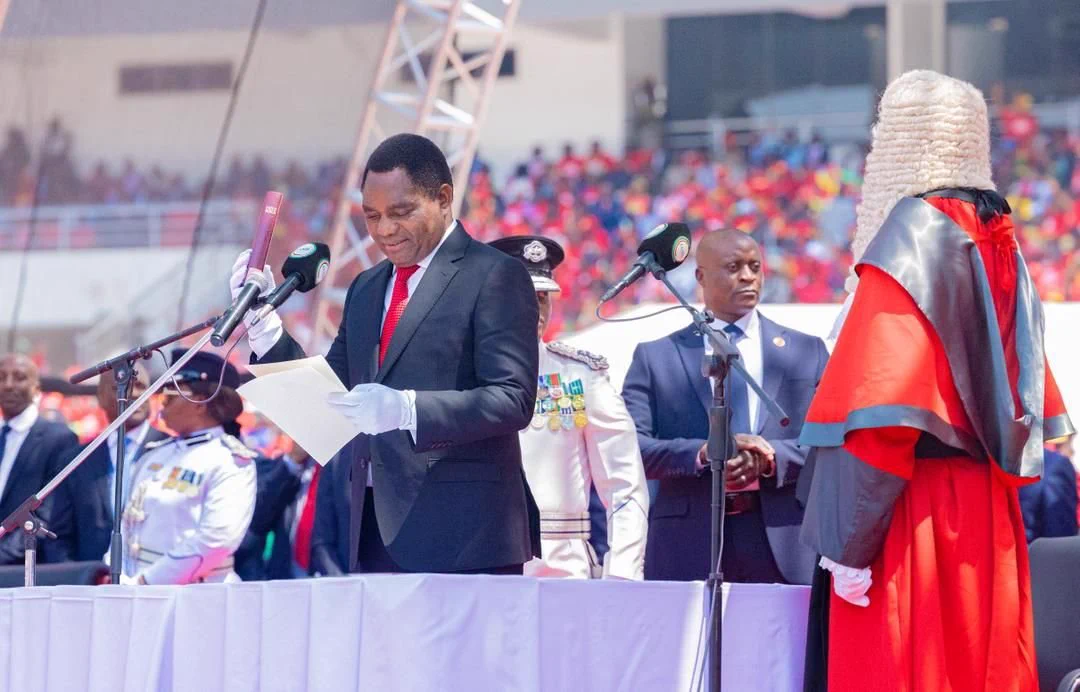
Zambia’s President, Hakainde Hichilema has been sworn in for a second five-year term amid a disputed election, following allegations of irregularities and the arrest of his main challenger, Brian Mundubile, on treason charges.
Hichilema, 64, was sworn in at the National Heroes Stadium in the capital, Lusaka, after official results showed he won the 13 August presidential election with 60 percent of the vote.
Mundubile, who secured 38 percent, rejected the result, alleging that the vote had been manipulated.
He was unable to challenge the outcome in court after the courts were sealed off last week on the final day for filing an electoral petition.
Election observers said voting on election day was largely peaceful but raised concerns about the vote-tallying process.
European Union observers reported that officials at several tallying centres failed to record results on tally sheets immediately after they were announced.
They also cited weak verification between digital entries and paper records, while returning officers frequently suspended proceedings while awaiting instructions from headquarters.
Tensions escalated after the election when security forces raided a property in Lusaka linked to Mundubile. A former cabinet minister was killed during the operation, while several opposition politicians were arrested.
The authorities accused the opposition of planning an armed insurrection, an allegation the opposition denied.
Mundubile and his running mate, Makebi Zulu, went into hiding before they were arrested by police last week and charged at the weekend.
Hichilema did not refer directly to Mundubile’s detention in his inauguration speech but warned against allowing political competition to undermine national stability.
“The pursuit of political power must never come at the expense of peace, security and stability in our country,” he said.
Call for Cooperation
Hichilema also called for cooperation between the government and opposition, saying democracy required respect despite political differences.
“When you have a good idea, we will listen to you,” he said.
His running mate, Mutale Nalumango, was also sworn in as vice-president.
Thousands of supporters gathered at the stadium for the inauguration, while presidents and senior representatives from Kenya, Botswana, Zimbabwe, Namibia and Tanzania attended the ceremony.
Hichilema first came to power in 2021 after defeating then-President Edgar Lungu in a landslide victory.
At the time, Zambia had recently defaulted on its international debt and was facing annual inflation of more than 24 percent.
Since taking office, Hichilema’s administration has negotiated a restructuring of the country’s debt and improved relations with international creditors. Inflation has also fallen, although the rising cost of living continues to affect many Zambians.
“We inherited a broken-down country… the economy was declining,” .
The president has pledged to shift the country from economic stabilisation to stronger growth during his second term.
“We are moving from stabilisation to growth,” he said in his inauguration speech.
“Having done the heavy lifting in our first term, the next five years is all about growth and prosperity for all our people. I will continue to be a servant president for all the people of Zambia,” he added.
Zambia’s economic outlook has also received a boost from rising copper prices. The World Bank estimates that copper accounts for about 15 percent of the country’s Gross Domestic Product and more than 70 percent of its exports.
Despite concerns over the election and the treatment of opposition figures, investor confidence in the copper-rich country remains relatively strong
