



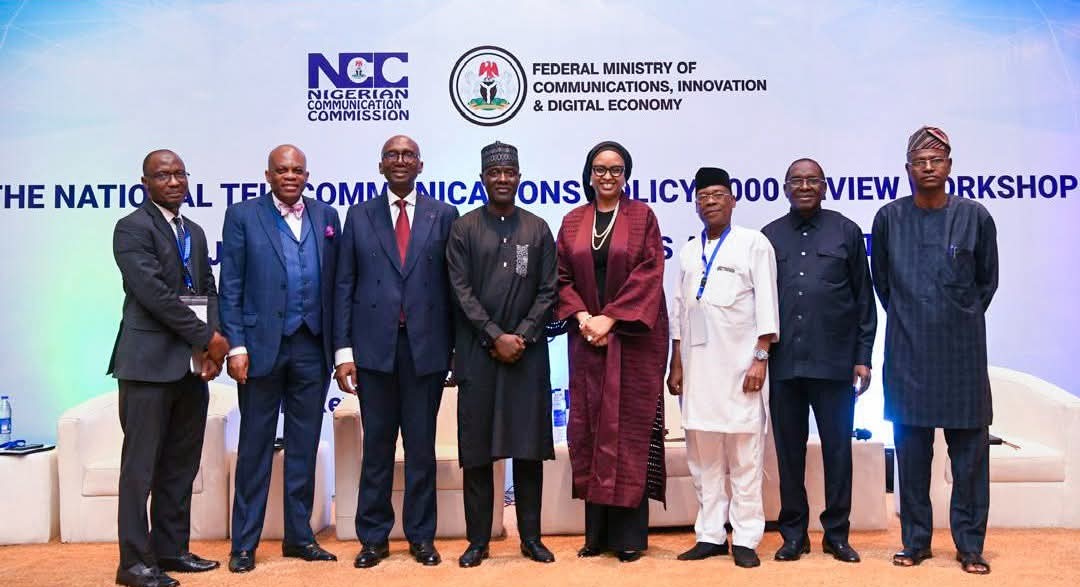
The Nigerian Communications Commission (NCC) has commenced a two-day Stakeholders’ Policy Review Workshop in Lagos to reassess the National Telecommunications Policy (NTP) 2000 and reposition Nigeria’s digital economy for emerging technological realities.
The workshop drew regulators, policymakers, industry leaders, academics, development partners, and other telecommunications stakeholders to evaluate the impact of the policy introduced over two decades ago and chart a new direction for the sector.
The Executive Vice Chairman and Chief Executive Officer of the NCC, Aminu Maida, described the exercise as a strategic national conversation on the future of Nigeria’s telecommunications and digital ecosystem.
He recalled that when the National Telecommunications Policy was introduced in 2000, Nigeria’s telecom sector was largely underdeveloped, with fewer than 500,000 active telephone lines serving over 120 million people under the monopoly of the defunct Nigerian Telecommunications Limited (NITEL).
According to him, the policy successfully liberalised the sector, attracted private investment, promoted healthy competition, and laid the foundation for independent regulation through the Nigerian Communications Act 2003.
Dr. Maida noted that the sector has evolved far beyond basic voice services into a complex digital ecosystem powering banking, fintech, e-commerce, healthcare, education, entertainment, cloud services, and digital identity systems.
He explained that Nigeria was now entering a new era shaped by technologies such as 5G, artificial intelligence, satellite broadband, the Internet of Things (IoT), cloud infrastructure, and cybersecurity, stressing that telecommunications should no longer be viewed as a stand-alone sector but as critical infrastructure driving national productivity and economic growth.
He further stated that regulation in Nigeria had evolved from simple market liberalisation to collaborative digital governance involving institutions such as the Nigeria Data Protection Commission (NDPC), Central Bank of Nigeria (CBN), Federal Competition and Consumer Protection Commission (FCCPC), National Information Technology Development Agency (NITDA), National Identity Management Commission (NIMC), and other public agencies.
The Special Adviser to the President on Policy and Coordination, Hadiza Bala Usman, described telecommunications as a major driver of economic inclusion and government reforms.
She said the review of the policy aligns with the digital economy agenda of President Bola Ahmed Tinubu, noting that strong digital infrastructure remains central to improving governance, financial inclusion, and national competitiveness.
Former Executive Vice Chairman of the NCC, Ernest Ndukwe, commended the commission for initiating the review, saying the telecommunications industry had undergone a massive transformation over the past 26 years.
Ndukwe observed that while the original policy laid the foundation for telecom sector liberalisation, emerging realities such as Fifth Generation (5G) networks, artificial intelligence, cloud computing, and digital services now require fresh policy directions to keep Nigeria globally competitive.
Also speaking, Oladojo Olawumi of the Special Duties Unit in the office of the Director-General of the National Information Technology Development Agency stressed the importance of inter-agency collaboration in building a secure and inclusive digital economy.
He advocated policies that would support digital literacy, local content development, emerging technologies, and innovation-driven enterprises across the country.
Representatives of the Nigeria Data Protection Commission also highlighted the importance of data privacy and digital trust in the evolving digital ecosystem, stressing that the protection of citizens’ data must remain a national priority through stronger regulations, cybersecurity frameworks, and responsible data governance.
Technical sessions at the workshop focus on the evolution of the National Telecommunications Policy, strategies for bridging the digital divide, building a resilient and secure digital future, global best practices in telecommunications regulation, and stakeholder feedback on the commission’s policy proposals
