



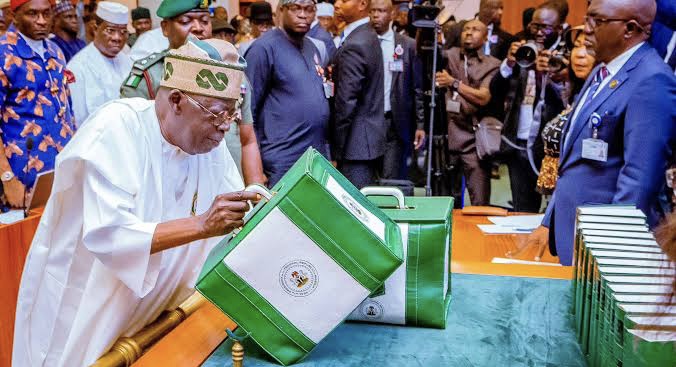
The Senate on Tuesday approved the 2026 Appropriation Bill, increasing the proposed budget to N68.323 trillion, an addition of over N9 trillion to the initial figure submitted by President Bola Tinubu.
The upward revision is aimed at addressing legacy obligations, funding critical infrastructure, strengthening the judiciary, boosting healthcare interventions and supporting preparations for the 2027 general elections.
Chairman of the Senate Committee on Appropriations, Senator Solomon Adeola, while presenting the report, said the adjustment was necessary to regularise outstanding commitments from previous fiscal years, align the budget with current economic realities and maintain macroeconomic stability.
President Tinubu had initially presented a N58.18 trillion budget proposal to the National Assembly on December 19, 2025. Tagged the “Budget of Consolidation, Renewed Resilience and Shared Prosperity,” the proposal prioritised economic growth, with major allocations to security and capital projects.
However, the revised budget, now passed by both chambers of the National Assembly, reflects a significant increase in overall spending.
A breakdown of the revised proposal shows that N4.799 trillion is allocated to statutory transfers, N15.809 trillion to debt servicing, N15.427 trillion to recurrent (non-debt) expenditure, while a substantial N32.287 trillion is earmarked for capital expenditure, reflecting a strong commitment to infrastructure development and economic expansion.
The committee explained that the adjustments totalling N9.09 trillion became necessary following a formal communication from the president seeking to incorporate critical expenditures omitted in the initial proposal and to ensure that unresolved obligations from previous budgets do not undermine the 2026 fiscal programme.
A major component of the adjustment is the inclusion of N7.71 trillion in outstanding capital obligations from the 2025 Appropriation Act.
According to the committee, these obligations are unlikely to be implemented before the expiration of the 2025 capital budget window, necessitating their rollover into the 2026 fiscal framework.
The lawmakers noted that about 70 per cent of capital projects in the 2025 budget were affected by revenue shortfalls, underscoring the need for continuity in funding to avoid project abandonment and cost escalation.
In addition to clearing legacy liabilities, the committee introduced new provisions targeting strategic national interventions across critical sectors.
Foremost among these is a N478.6 billion Federal Government equity contribution under the Ministry of Finance Incorporated (MOFI) framework to support presidential legacy light rail projects in Lagos, Kano, Kaduna and Ogun States.
The provision also covers feasibility studies for proposed urban rail systems in Enugu and Maiduguri, as well as improvements to the narrow-gauge railway network.
The committee further approved N8.96 billion for feasibility studies on the Calabar–Maiduguri corridor and the Maiduguri–Sokoto superhighway under the Tinubu National Beltway Initiative, a project designed to enhance regional integration and facilitate trade across multiple zones of the country.
In the health sector, an additional $344.83 million, equivalent to about N482.76 billion, was provided for priority interventions tied to existing bilateral agreements and implementation commitments.
The committee said the funding would support efforts to strengthen healthcare infrastructure and service delivery nationwide.
The judiciary also received a significant boost as part of preparations for the 2027 general election.
The committee approved N98.5 billion for the Court of Appeal, N36.7 billion for the Supreme Court, and N268.54 billion to restore the judiciary’s budget ceiling and accommodate the anticipated appointment of additional justices and judges.
The lawmakers emphasised that strengthening the judiciary was critical to sustaining democratic governance, particularly in managing election-related disputes and ensuring timely dispensation of justice.
To finance the expanded budget, the committee proposed a mix of revenue-enhancing measures and borrowing.
Chief among these is a $10 per barrel increase in the oil benchmark, projected to generate an additional N2.592 trillion in revenue.
The committee also highlighted the growing contribution of the telecommunications sector to government revenue, noting that recent tariff adjustments and policy reforms have improved the sector’s viability and attracted over $2 billion in new investments.
As a result, MTN Nigeria is projected to generate N724 billion in company income tax in 2026, while Airtel Nigeria is expected to contribute N150 billion, bringing total additional revenue from the sector to N874 billion.
Despite these revenue measures, the committee approved an increase in external borrowing by N6.163 trillion to cover the remaining financing gap, while maintaining that the borrowing plan remains within manageable limits.
The report underscored that the 2026 budget is designed to consolidate macroeconomic stability, improve the business and investment climate, promote job creation and reduce poverty, in line with the administration’s policy objectives.
It added that the budget prioritises key sectors such as security, infrastructure, health, education and human capital development, with the aim of delivering inclusive growth and improved living standards for Nigerians.
The committee also recalled that the Senate had earlier debated the general principles of the bill in December 2025 before referring it for detailed scrutiny.
It noted that the legislative process included engagements with the president’s economic team, comprising the ministers of finance and budget and economic planning, as well as the accountant-general and the director-general of the budget office.
In furtherance of transparency and inclusiveness, the committee organised a public hearing on February 9, 2026, themed ‘From Budget to Impact,’ where inputs were received from ministries, departments and agencies, civil society organisations, development partners and private sector stakeholders.
The committee said the consultative process enriched the budget and ensured that it reflects the aspirations of Nigerians across various sectors.
However, the lawmakers expressed concern over bureaucratic bottlenecks that hampered budget implementation in 2025, particularly delays in the release of funds.
They stressed the need for urgent reforms to address these challenges, warning that failure to do so could undermine the effectiveness of the 2026 budget.
To this end, the committee recommended stronger collaboration between the executive and legislature, as well as enhanced oversight by relevant committees to ensure disciplined and timely execution of projects.
It also called for deliberate efforts to translate budgetary provisions into measurable outcomes, in line with the overarching theme of the 2026 budget: “From Budget to Impact: Strengthening Macroeconomic Stability, Accelerating Infrastructure Delivery, and Improving Security through Fiscal Discipline and Effective Implementation.”
To ensure continuity in project execution, the committee recommended extending the 2025 Appropriation Act to June 30, 2026, providing additional time for the completion of ongoing projects.
Chairman of the Senate Committee on Appropriations commended his members and stakeholders for their contributions to the process, noting that collaboration with the House of Representatives ensured a harmonised and balanced report.
He said the committee’s work reflects a shared commitment to fiscal responsibility, transparency and national development.
The committee ultimately urged the Senate to approve the revised appropriation bill, describing it as a critical instrument for consolidating economic gains, addressing structural challenges and setting the country on a path of sustainable growth.
With the approval, the 2026 budget became Nigeria’s largest ever, highlighting both the scale of the nation’s fiscal challenges and the government’s determination to drive recovery, stability and long-term prosperity.
