


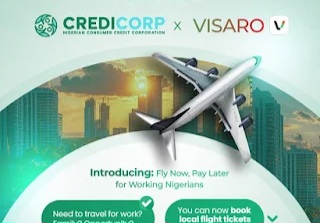
The Federal Government has rolled out a ‘Fly Now, Pay Later’ consumer credit scheme to ease the financial burden on Nigerian travellers on domectic flights. The initiative, unveiled by the Nigerian Consumer Credit Corporation (CREDICORP) on Tuesday via its official X handle, enables eligible passengers to book local flights and spread payments over time through structured financing.
The move comes as many Nigerians grapple with soaring ticket prices, which have made air travel increasingly unaffordable despite rising demand for intercity connectivity. During the 2025 yuletide period, one-way fares on some domestic routes surged by about 150 percent, climbing above N300,000.
Airlines have linked the spike to escalating aviation fuel costs, foreign exchange constraints, and other operational challenges. CREDICORP said the new credit solution is designed to remove the upfront payment barrier that often delays critical travel plans. “Through this initiative, eligible customers can book domestic flights today and repay the cost over time through structured financing,” the corporation stated.
The programme is being implemented in partnership with MyVisaro and Alert Microfinance Bank, as part of broader efforts to expand access to responsible consumer credit and promote financial inclusion.
Prospective beneficiaries are encouraged to apply through the Visaro platform to access the facility and book flights across the country. CREDICORP noted that the scheme aligns with its mandate to improve Nigerians’ access to essential services through innovative financial solutions. “At CREDICORP, we remain committed to enabling Nigerians to live better now. Fly now. Pay later. Opportunity shouldn’t wait,” it added.
FG Okays Electric Buses For Civil Servants To Boost Local Auto Industry
Meanwhile, the Federal Government has approved the acquisition of electric buses for civil servants as part of efforts to promote local vehicle assembly and accelerate Nigeria’s transition to cleaner transportation.
The Director-General of the National Automotive Design and Development Council (NADDC), Joseph Osanipin, said this during a briefing for journalists in Abuja on Tuesday.
Osanipin said the buses would be sourced from local assemblers to strengthen domestic manufacturing and boost growth in Nigeria’s automotive sector.
He said the government had also procured charging infrastructure that would be installed in parts of the country to support the deployment and adoption of electric vehicles. According to him, the initiative aims to encourage the transition to cleaner mobility while creating opportunities for local manufacturers.
Osanipin also said the council was establishing an automotive development park in Nnewi, Anambra, to strengthen Nigeria’s automotive ecosystem. He said the facility, known as the Nnewi Automotive Development Park, would provide shared infrastructure for automotive manufacturers and component producers.
“We are developing the Nnewi Automotive Development Park, where we will provide the necessary infrastructure so that users of the park can share facilities.
“The arrangement will allow investors and manufacturers to operate without having to individually provide all the required infrastructure before establishing operations,” he said. He said the council was currently seeking additional investment to accelerate development of the park and attract more players into the sector.
Osanipin urged Nigerians to patronise locally assembled vehicles, noting that doing so would help create jobs and stimulate economic growth. He said NADDC was also providing training to manufacturers and other stakeholders to promote local production of vehicle components such as batteries and tyres.
The director-general said the move would reduce import dependence, create employment opportunities and contribute to the country’s gross domestic product. He said the council was working with the Bank of Industry (BoI) to facilitate the disbursement of the National Automotive Development Fund to qualified stakeholders.
Osanipin also said NADDC was working toward forwarding a bill to the National Assembly of Nigeria to strengthen the council’s operations in line with global best practices. He reiterated the council’s commitment to repositioning Nigeria’s automotive industry and called for continued support from investors and stakeholders.
