



President Bola Tinubu on Monday warned judicial officers across the country, insisting that justice must remain sacred and insulated from corruption, declaring bluntly that “justice must never be for sale.”
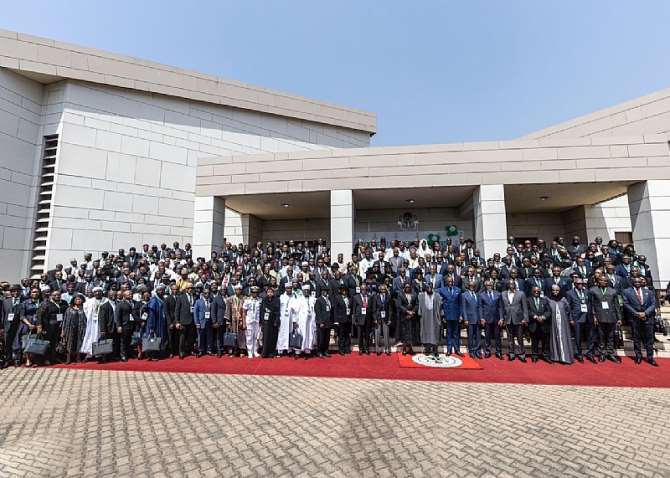
Speaking at the opening of the 2025 All Nigerian Judges’ Conference of the Superior Courts in Abuja, Tinubu said the Judiciary must purge itself of compromise, insisting that corruption within the Bench strikes at the very foundation of the Nigerian state.
The event, attended by top judicial officers, senior government officials, and members of the legal community, provided yet another opportunity for the President to fault the slow pace of justice delivery and the growing distrust Nigerians have in the judicial system.
Addressing the judges, Tinubu declared that no reform within the judicial sector would succeed without “unwavering integrity.”
He said the country cannot afford a Judiciary that trades fairness for personal gain.
“Justice must never be for sale, and the Bench must never become a sanctuary for compromise,” the President warned.
“Corruption in any arm of government weakens the nation, but corruption in the Judiciary destroys it at its core.”
Tinubu added that every judicial officer — not just the National Judicial Council (NJC) — must take responsibility for safeguarding the integrity of the courts.
The President decried the massive backlog of cases across Nigerian courts, describing the situation as an assault on democracy and public trust.
According to him, Nigerians are tired of waiting years for justice while cases stagnate in courts without resolution.
“The backlog of cases in our courts must be addressed with urgency. Our courts must no longer be places where cases languish for years,” Tinubu said.
“Justice exists for the people, and their faith in the judicial process is the foundation of our national stability.”
He added that delayed judgments and questionable conduct among some judicial officers continue to fuel public frustration.
“These Perceptions Cannot Be Ignored.”
Tinubu acknowledged that Nigerians have repeatedly complained about the Judiciary’s credibility, saying even if those criticisms are not fully justified, the system cannot pretend nothing is wrong.
“These perceptions, whether wholly justified or not, cannot be ignored. They call upon us to reflect, to reform, and to restore,” he said.
Tinubu reaffirmed his administration’s commitment to supporting the Judiciary not just through rhetoric but concrete investment in digital tools, infrastructure, and training.
He said the future of judicial work must rely heavily on technology, digitised court processes, and modern case-management systems.
“Support must be tangible, not ceremonial,” Tinubu said. “We will prioritise modern infrastructure, digital processes, and efficient case management. A digital, transparent judiciary will deepen accountability and public trust.”
The President urged judges across all levels to adopt strict disciplinary standards, reduce congestion in courts, and make justice more affordable and accessible to ordinary Nigerians.
Declaring the conference open, he noted that the country’s democracy continues to depend heavily on the courage, fairness, and integrity of judicial decisions.
“Each fair judgment strengthens the Republic; each courageous ruling preserves its soul,” Tinubu added.
