



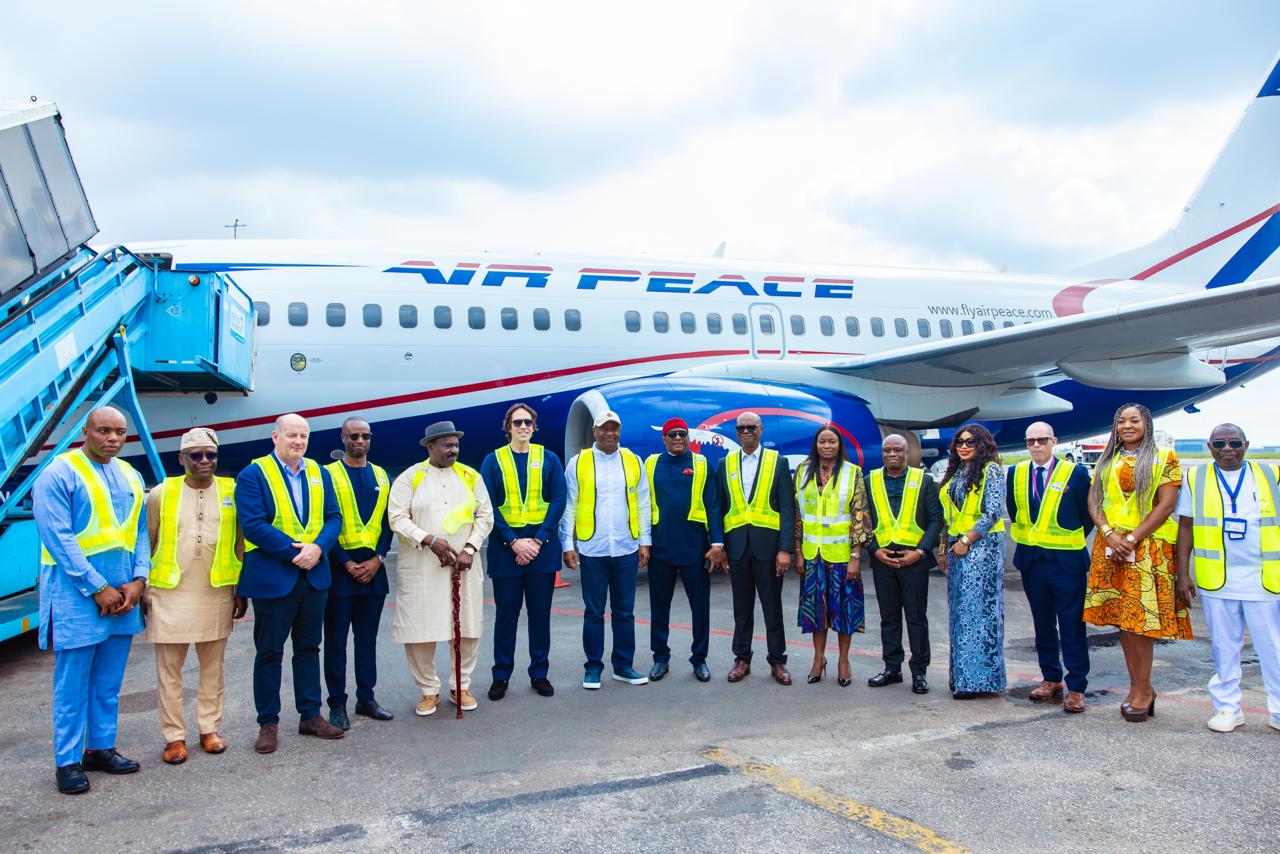
Nigeria’s aviation sector reached a major milestone on Friday with the arrival of a Boeing 737-700NG aircraft leased by Air Peace, marking the country’s first dry lease delivery in ten years and a renewed vote of confidence from international lessors.
The aircraft, registered EL-HRN, touched down at Lagos’ Murtala Muhammed Airport to a warm reception by dignitaries from Boeing, AerCap, Fidelity Bank, the Irish Embassy, and the Federal Ministry of Aviation and Aerospace Development. For many, the event symbolized Nigeria’s restoration of credibility within the global aviation finance market — a status it lost a decade ago.
A New Chapter for Nigerian Aviation
Minister of Aviation and Aerospace Development, Festus Keyamo, described the moment as “emotional and historic,” noting that Nigeria had been blacklisted by global aircraft lessors for years due to past defaults and regulatory shortcomings.
According to Keyamo, the situation began to change after the signing of the Irrevocable Deregistration and Export Request Authorisation (IDERA) Advisory Circular in 2023 — a key provision under the Cape Town Convention designed to protect lessors and assure them of asset recovery in case of disputes.
“When this government came in, we made it a priority to rebuild trust with international partners,” the minister said. “A wet lease is three times more expensive than a dry lease. What we’ve achieved today shows that Nigeria has regained integrity in global aviation circles.”
He praised Air Peace for its strong corporate governance and sound financial record, stressing that the airline’s reputation played a decisive role in convincing AerCap, one of the world’s largest aircraft leasing companies, to partner with a Nigerian carrier again.
Air Peace Leads the Way
Air Peace Chairman, Dr. Allen Onyema, confirmed that the Federal Government provided a sovereign guarantee to support the lease agreement, adding that the deal sets a new standard for Nigerian operators.
“Most global airlines run on dry-leased aircraft — Nigeria cannot remain an exception,” Onyema said. “This is a new dawn for our aviation sector. We’re not just taking delivery of one plane; this opens the door for many more. We expect additional aircraft to arrive soon.”
Onyema further explained that the dry lease arrangement — where the airline provides its own crew, insurance, and maintenance — gives operators greater control, flexibility, and cost efficiency. He noted that Air Peace plans to expand its fleet significantly to meet growing demand across West and Central Africa and on international routes.
Renewed Confidence and Collaboration
Other speakers at the event echoed optimism about Nigeria’s aviation prospects. The Irish Ambassador to Nigeria, Peter Ryan, commended both the government and Air Peace for implementing the Cape Town Convention effectively, while Boeing’s Sales Director for Africa, Moore Ibekwe Jr., disclosed that the dry lease discussions with Nigeria had been ongoing for two years.
Fidelity Bank’s Executive Director, Dr. Kenneth Okpara, also highlighted Air Peace’s prudent financial practices, describing the airline as a model of accountability and transparency within the sector.
Restoring Trust, Empowering Local Carriers
For Nigeria, the successful delivery of this aircraft represents more than a business transaction — it is a turning point for the country’s aviation reputation. By regaining the trust of global financiers and lessors, Nigerian airlines can now access modern fleets on competitive terms, reducing dependence on costlier wet leases and curbing foreign dominance on local routes.
As Keyamo noted, “Nigeria has reached the junction where confidence in our aviation system is being restored. That confidence will empower our local operators, expand our capacity, and strengthen our place in global aviation.”
The delivery of Air Peace’s dry-leased Boeing 737 thus stands not only as a commercial success but as a symbol of renewal — signaling that Nigeria’s skies are once again open for sustainable growth and international partnership
