


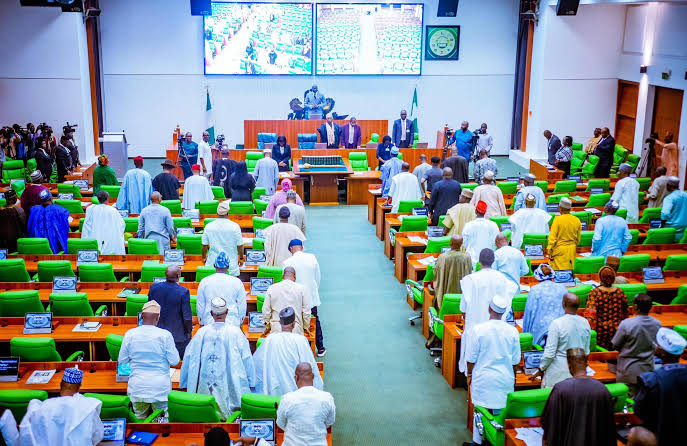
The National Assembly on Wednesday approved President Bola Tinubu’s request to secure $2.347bn in foreign loans to part-finance the 2025 budget deficit and refinance Nigeria’s maturing Eurobonds.
The approval, granted separately by the Senate and the House of Representatives, also included authorisation for the issuance of a $500m debut Sovereign Sukuk in the international capital market.
In the House of Representatives, the approval followed the adoption of a report presented by the Committee on Aids, Loans, and Debt Management, chaired by Abubakar Nalaraba, during plenary presided over by the Speaker, Tajudeen Abbas.
The committee’s report indicated that $1.23bn would fund the 2025 budget deficit, while $1.12bn would be used to refinance Eurobonds maturing in November 2025.
The House authorised the Federal Government to implement the external borrowing component of the 2025 Appropriation Act amounting to about N1.84tn (approximately $1.23bn at an exchange rate of N1,500 to $1).
It also approved that the loans be accessed through Eurobond issuance, loan syndication, bridge financing, or direct borrowing from international financial institutions.
Similarly, the Senate approved Tinubu’s request to obtain a total of $2.847bn in fresh foreign loans, including the $500m Sukuk bond, after adopting a report by its Committee on Local and Foreign Debts chaired by Senator Wamakko Aliyu (APC, Sokoto North).
According to the Senate’s breakdown, $2.347bn will be raised from the international capital market to part-finance the 2025 budget, while $500m from the Sovereign Sukuk will fund key infrastructure projects across the country.
The Senate’s approval comes amid growing public concern over Nigeria’s rising debt profile, which the Debt Management Office recently put at over N97tn as of mid-2025.
While critics warn of increasing fiscal pressure, government officials maintain that strategic borrowing is crucial to sustaining economic growth, bridging infrastructure gaps, and maintaining investor confidence.
Presenting his committee’s report, Senator Wamakko said the borrowing plan was essential to ensure project continuity and protect Nigeria’s international credit reputation.
Supporting the motion, the Chairman of the Senate Committee on Finance, Senator Sani Musa (APC, Niger East), said the approval was critical for implementing the 2025 Appropriation Bill.
“It is very necessary that we give approval to this request so that the 2025 appropriation will be given the necessary funding,” Musa said.
Also contributing, the Chairman of the Senate Committee on Banking, Insurance, and Other Financial Institutions, Senator Adetokunbo Abiru (APC, Lagos East), clarified that the new borrowing would not add to the country’s debt stock but rather refinance existing obligations.
“This is a compliance measure because the 2025 Appropriation Act already captured it as part of deficit financing. The second request is a refinancing arrangement to ensure that the country does not default on Eurobond servicing,” Abiru explained.
On his part, the Chairman of the Senate Committee on Interior, Senator Adams Oshiomhole (APC, Edo North), said properly structured loans could stimulate economic growth and create jobs.
“There’s nothing wrong with borrowing if it is well managed and channelled towards productive sectors,” Oshiomhole said
