



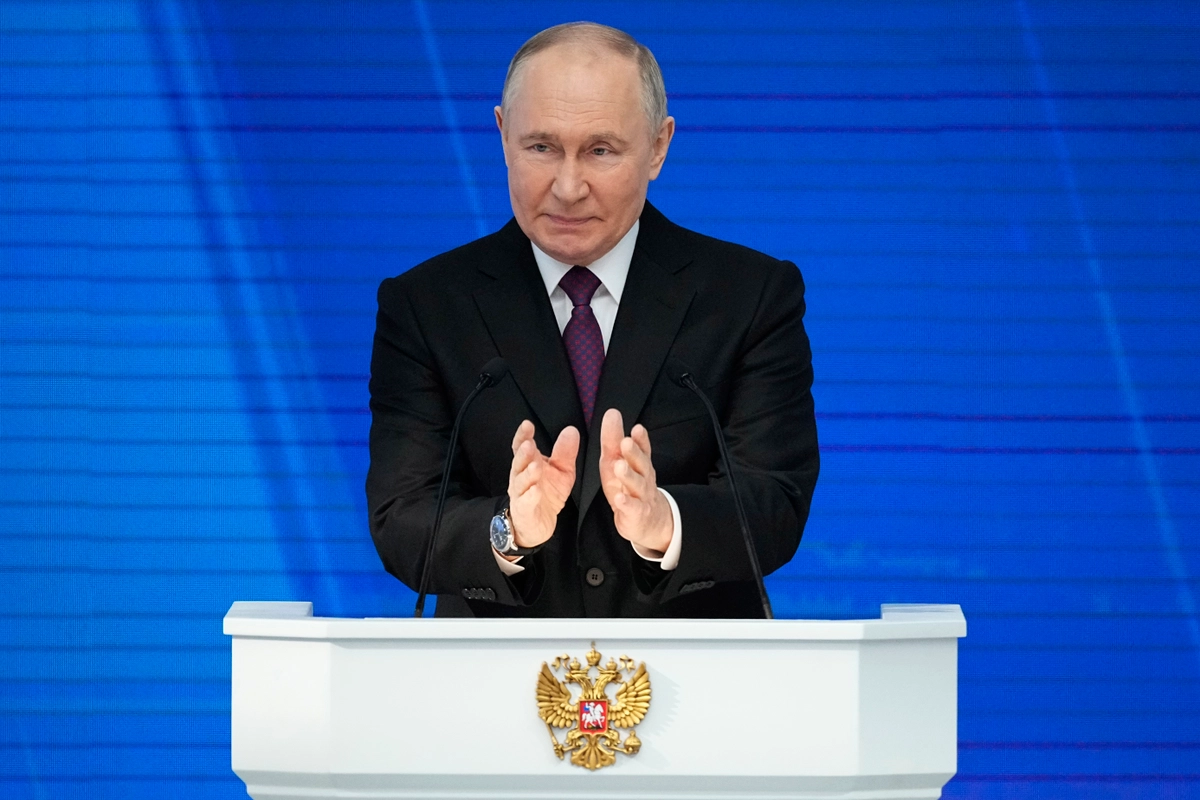
Russia’s Finance Ministry has announced an increase in VAT despite pledges by Vladimir Putin that he will not burden the Russian population with more taxes.
The ministry said on Wednesday that it plans to raise VAT by two percentage points to 22% as part of a three-year strategy to address a growing budget deficit caused by the spiraling cost of the war on Ukraine.
Research by the Stockholm International Peace Research Institute published in April found that Russia’s total military expenditure could hit 15.5 trillion rubles (€511 billion) this year.
Last year, VAT made up over 15% of the government’s total revenue.
Putin had pledged, shortly after his inauguration for a fifth term in May 2024, to avoid major tax changes until 2030 but has struggled to uphold this commitment as the government looks for more revenue to fund the war.
Central bank governor Elvira Nabiullina warned at a press conference earlier this month that the widening budget deficit was the biggest risk to inflation, which is currently running at over 8%, according to official figures.
Beyond raising VAT, the Finance Ministry plans to expand the tax base by lowering the revenue threshold for small and medium-sized businesses to report taxes, dropping it from 60 million rubles (€609,930) to 10 million rubles (€102,000).
Additionally, a 5% tax on gambling and a 25% income tax on bookmakers will be introduced. The ministry stated that these measures are “aimed primarily at financing defense and security.”
Economic slowdown
For three years, Russia has funded the war largely through oil and gas exports and by tapping into the National Welfare Fund, built up during years of surplus energy revenue.
The economy, fueled by a shift to a war footing, has also generated higher tax revenue in recent years, Politico reported.
However, economic growth has slowed in 2025 as a credit boom fizzled out. Economy Minister Maxim Reshetnikov noted earlier this month that the economy “is cooling faster than expected.”
Falling crude oil prices, driven by increased production from Saudi Arabia and the UAE, are projected to reduce Russia’s oil and gas revenue by 23% this month, according to Reuters estimates.
Originally, the Finance Ministry planned to replenish the National Welfare Fund this year, but May projections indicated a need to draw down about 10% of its remaining liquid assets in 2025.
Now, the ministry will lower the oil price threshold that directs tax revenue to the reserve fund, diverting more to the general budget instead.
The Finance Ministry presented these proposals to the cabinet on Wednesday, just days before submitting a formal 2026 budget to the Duma.
The announcement follows a shift in tone from U.S. President Donald Trump, who posted on social media that “Putin and Russia are in BIG Economic trouble” and that Ukraine’s drone strikes on Russian oil refineries make Russia look like a “paper tiger.”
