



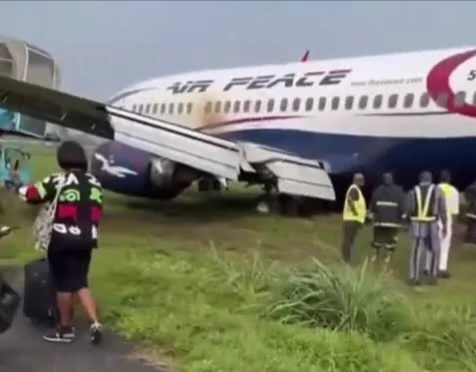
An Air Peace pilot and a co-pilot have tested positive for taking hard drugs and alcohol, a report by the Nigerian Safety Investigation Bureau (NSIB), has shown.
The Bureau said that the crew positive for the substances after the aircraft they flew was involved in a runway excursion at the Port Harcourt International Airport on July 13, 2025.
“Initial toxicological tests conducted on the flight crew revealed positive results for certain substances, including indicators of alcohol consumption. A cabin crew member also tested positive for THC, the psychoactive component in cannabis. These results are being reviewed under the human performance and safety management components of the investigation,” the report read in part.
“Toxicological screening conducted post-incident revealed that Captain and first officer tested positive for Ethyl Glucuronide, indicating recent alcohol consumption.”
The NSIB said the toxicology results suggested human performance was a critical factor in this case.
Based on its finding, the Bureau recommended that Air Peace strengthen its crew resource management training and tighten checks on pilot fitness before dispatch.
The pilots were flying an Air Peace Boeing 737 aircraft and were involved in a serious incident while carrying 103 passengers.
“The aircraft, operating as a scheduled domestic flight from Lagos to Port Harcourt with 103 persons on board, landed long on Runway 21 after an unstabilised final approach. The aircraft touched down 2,264 metres from the runway threshold and came to a final stop 209 metres into the clearway,” the report stated.
“All passengers and crew disembarked safely, and no injuries were reported.”
According to the report, the domestic flight, which took off from Lagos, experienced an unstabilised final approach before landing long on Runway 21.
The investigators revealed that the aircraft touched down 2,264 metres from the runway threshold, well beyond the recommended touchdown zone, and eventually came to a stop at 209 metres into the clearway.
Runway excursions are one of the most frequent safety risks in commercial aviation, often caused by poor visibility, pilot error or technical faults
